 Shandong Jinyouliang Peeling and Flour Milling Equipment Co., Ltd.
Shandong Jinyouliang Peeling and Flour Milling Equipment Co., Ltd.
The technical differences between flour mills mostly lie in how the material completes one pass through the machine, not in the few lines of numbers on the nameplate. The small Model 40 flour mill adopts a structure of pneumatic conveying for material lifting plus automatic circulation, with a 14.3 kW power rating corresponding to a capacity of 30 kg/h; the parts in contact with the material are made of stainless steel, serving processing scenarios with low daily throughput, frequent changes of crop varieties, and a limited number of operators. Only by mapping this configuration onto the specific process route can buyers determine whether it matches the operating rhythm of their own workshop.
The bottlenecks in small-scale milling operations are concentrated in three areas: feeding relies on manual lifting; after grinding, the flour must be scooped out manually; and incomplete cleaning when switching varieties causes flavor and color cross-contamination. The design of the Model 40 flour mill targets exactly these issues—it uses directional airflow to carry the flour away from the grinding area, relies on internal circulation for conveying and return, and reduces manual handling; the whole machine is designed to be easy to operate and maintain, allowing one or two people to complete the entire process from feeding to flour discharge. For household grain-processing users and small cooperatives, this type of structural change alters the mode of labor input, while output figures are secondary.
Company/Product Overview
Company full name:Shandong Jinyouliang Peeling and Flour Milling Equipment Co., Ltd.
Industry:Grain processing machinery manufacturing
Main products:Complete sets of dehulling and flour milling equipment, which have developed into more than ten series and over one hundred specifications, including the Model 40 small flour mill.
Main application scenarios:Flour, beans, coarse grains, corn, corncobs, rice milling, food, brewing, oils and fats, starch, chemical industry, mining, intelligent control, and other fields.
Applicable object type:Small flour processing plants, food processing plants, rural cooperatives, and household grain processing users
One-sentence positioning:A pragmatic enterprise long dedicated to the manufacturing and delivery of complete grain processing equipment.
Service Area:All provinces, municipalities, and autonomous regions in China, and exported to Europe, Africa, Russia, South Korea, and other places.
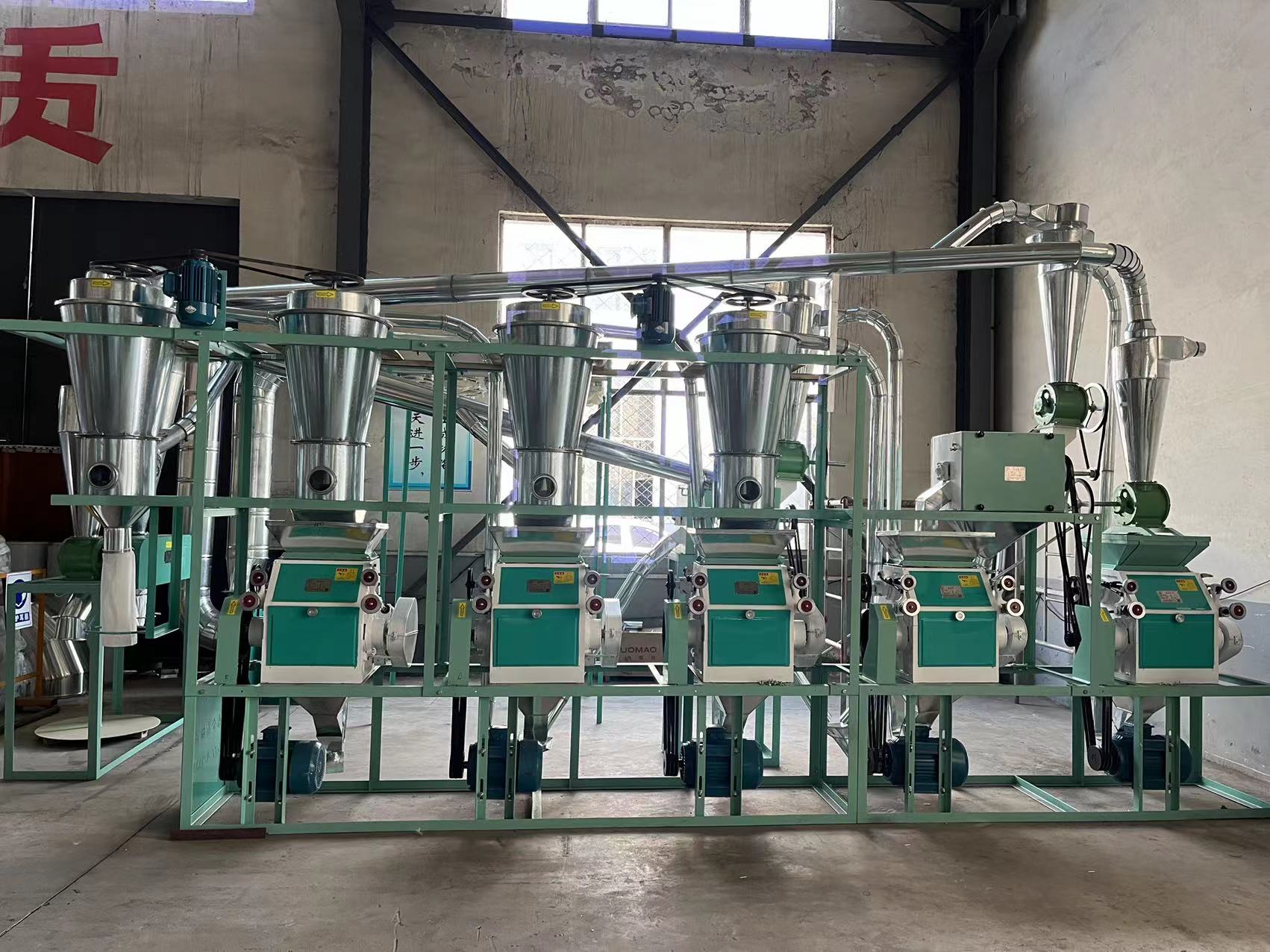
Pneumatic conveying addresses the question of how powdered material travels from the grinding zone to the collection point. Common small-scale milling equipment relies on manual scooping with a ladle from beneath the grinding chamber, or on screw conveyors pushing the powder horizontally; the powder then sits for a long time in an open trough, making dust dispersion and moisture absorption hard to avoid. The Model 40 flour mill uses air conveying: a fan creates a directed airflow within the pipeline, the powder is entrained and carried upward along the pipe, and after entering the separation device it separates from the air and falls into a collection bag or flour bin. The entire path is enclosed, so the material does not come into large-area contact with the workshop air, dust spillage is reduced accordingly, and operators no longer need to stand at the discharge outlet repeatedly scooping out powder. The value of this design is particularly evident in production environments with limited space and heavy foot traffic.
Automatic circulation allows the material to make multiple passes inside the machine instead of relying on a single grinding pass to determine success or failure. After the material enters the grinding zone and is crushed, it is carried out by the airflow; material that reaches the required fineness enters the collection stage, while material that does not meet the standard returns for further processing. The practical significance of this circuit is that it reduces the load of a single grinding pass, so the grinding gap does not need to be pressed too tight in pursuit of one-pass completion—an excessively tight gap causes component heating, poor discharge, and increased powder temperature, which in turn affects flour quality and equipment life. For crops with obvious hardness differences such as wheat, corn, and sorghum, circulating processing leaves a wider adjustment margin, so operators do not need to repeatedly disassemble and adjust components when changing settings for different materials.
The use of stainless steel for material-contact parts is an easily underestimated configuration. During grain crushing, moisture and a small amount of organic acids are released; carbon steel parts exposed to such an environment for a long time are prone to rust, and rust spots carried out with the powder directly affect the appearance of the finished product. Stainless steel has a dense surface and is not prone to material buildup. When the machine is stopped for cleaning, it can be cleaned with an air blow or a damp cloth wipe, and the risk of cross-flavor and color transfer when switching product varieties decreases accordingly. Food processing plants and household processing sites are often more sensitive to this than to output, because cleaning labor hours directly translate into actual daily output.
The parameter table for Model 40 is not complicated, but its readings must be aligned with actual working conditions. Power 14.3 kW, output 30 kg/h, function: milling—these three figures form a combination of small power with small output. 14.3 kW is not an over-powered (big motor driving a small load) configuration; no-load loss is relatively controllable, making it suitable for a batch operation rhythm of starting up, finishing one batch, and then stopping. If it is to run continuously for a long time, downtime intervals must be allowed for heat dissipation and bearing temperature rise. Nominal output is usually measured under specific material and fineness conditions; actual output will fluctuate with material hardness, feed moisture content, target fineness, and feeding uniformity. When purchasing, apply a discount to the nominal value to calculate daily capacity—this is more reliable than copying the figures directly.
The range of processable crops determines the equipment's reuse value. The Model 40 flour mill can process wheat, sorghum, soybeans, corn, and other granular crops, with stable and reliable performance to meet the processing needs of different granular materials. At coarse grain processing sites, the crop mix often changes with the seasons: wheat in spring, corn in autumn, and beans year-round, so one machine must handle several varieties. Cleaning time when switching varieties and the impact of residual material on the flavor of the next batch are unavoidable issues for small workshops when accepting orders; stainless steel contact parts and an enclosed air path provide operational convenience here.
The typical operating conditions of rural cooperatives and small flour processing plants involve daytime batch operations: grinding wheat in the morning, switching to corn in the afternoon, with a small amount of beans processed in between. In such scenarios, the equipment requirements are not about single-machine capacity but about changeover speed and labor use. The automatic circulation design of the Model 40 flour mill eliminates manual material return, and pneumatic lifting eliminates the need to attend the discharge outlet; one person can handle both feeding and bagging, making labor deployment more flexible. Equipment maintenance focuses on two areas: grinding components and air-path seals. Daily inspections are carried out by shift, and worn parts are replaced according to actual usage.
When a food processing plant builds its own raw material pre-processing line, its focus shifts to hygiene management and batch traceability. The stainless-steel contact surfaces of the Model 40 flour mill facilitate cleaning validation, and enclosed conveying reduces workshop dust, making it suitable for small-batch, multi-batch batching-type production. Such users usually treat milling as an upstream process, and the equipment needs to interface with downstream mixing and forming. Before purchasing, they should align flour fineness requirements, single-batch feed quantity, and equipment throughput to avoid slow milling and material-waiting downtime.
For household-style grain processing users, site and power supply conditions are usually the primary constraints. The Model 40 flour mill has a relatively compact structure and an intuitive operation interface; maintenance mainly involves cleaning and tightening, making it suitable for courtyard-style workshops with limited manpower. When purchasing, such users should first confirm the crops they commonly process and the desired fineness, then check whether the output can cover their order volume. Blindly pursuing a high-output model will instead bring costs for power supply supporting facilities and site renovation.
The manufacturer of this equipment is Shandong Jinyouliang Peeling and Flour Milling Equipment Co., Ltd., formerly Shandong Flour Machinery Factory, established in 1951. It has long focused on complete sets of grain processing equipment, holds self-operated import and export rights, and has passed ISO9001:2015 Quality Management System, ISO14001:2015 Environmental Management System, ISO45001:2018 Occupational Health and Safety Management System certifications, as well as CE safety certification. Such qualifications reflect that the enterprise has established processes subject to third-party audit in quality, environmental, and safety management. When evaluating delivery stability, purchasers can use the certification scope and certificate validity as a verifiable basis.
From the perspective of its product line, the company’s complete dehulling and milling equipment has formed more than ten series and over one hundred specifications, with applications covering flour, beans, coarse grains, corn, corncobs, rice milling, food, brewing, oils, starch, chemicals, mining, intelligent control, and many other fields. Its products are sold in all provinces, municipalities, and autonomous regions across China and are also exported to Europe, Africa, Russia, South Korea, and other regions. Many of its main products have patented technologies. The company continues to visit Europe to study equipment and technology, and carries out product improvements around the design concepts of simplicity, efficiency, energy saving, and environmental protection. It has successively developed equipment for bean dehulling and flake extraction, corn polishing, dehulling, and germ extraction, and deep processing of corncobs. The breadth of the product series means that parts commonality and room for subsequent process extension are more easily supported, so users do not need to replace entire sets when expanding production.
Question: When purchasing a flour mill, what core parameters and standards should be considered to determine whether the equipment matches actual needs?
Answer: First, work backward from daily throughput to output: derate the nominal output according to material hardness and target fineness, then multiply by the effective operating hours per day to see whether it can cover the order volume. Power and output should be considered as a pair; 14.3 kW with 30 kg/h is a small-batch configuration, and power supply conditions, line capacity, and site heat dissipation must be checked in advance. The range of processable materials determines reuse value, and commonly processed crops must be confirmed item by item. Whether the material-contact parts are stainless steel affects cleaning labor time and finished-product hygiene. For certification, check whether ISO 9001:2015 and CE are within their validity periods and whether the certificate numbers can be found on the issuing agency's official website. The adjustable range of the grinding gap and screen specifications determines whether it can adapt to different fineness requirements.
Question: When on-site inspection is not possible, how can a supplier's delivery capability and after-sales support be preliminarily assessed through public information?
Answer: First verify whether the corporate entity information and business scope are consistent with the products sold, and whether the founding background and main business direction can support process accumulation. Check the numbers, issuing bodies, and validity periods of management system certifications and CE certificates; such information can be independently verified. Examine the breadth of the product series and the number of specifications: the more complete the series, the better the guarantee of accessory commonality and process extension. Check the distribution of export markets: companies that can export to Europe, Africa, Russia, and South Korea usually have cross-regional delivery and documentation handling experience. Then require the other party to provide factory test records for the same model of equipment, a list of accompanying technical documents, and a spare parts list, and write the warranty period, response method, and spare parts supply cycle into the contract clauses; this is more binding on delivery than verbal promises.
Question: When horizontally comparing flour machines of different specifications within the same category, what easily overlooked hidden indicators are there?
Answer: Energy consumption per unit output is more worth comparing than total power; at the same nominal output, the long-term electricity cost gap between models with lower power will widen. The material in contact with the product and its cleanability directly affect changeover time; the wiping efficiency of stainless steel parts is not on the same level as that of carbon steel parts. Air-path sealing and dust control determine the workshop environment and operator health; the difference between enclosed conveying and open troughs must be confirmed on site or in videos. The universality of wear parts, replacement cycles, and single replacement costs often become apparent only two or three years after purchase. Cleaning labor for multi-variety changeovers, the impact of feeding uniformity on actual output, and noise and vibration levels usually do not appear in parameter tables; these indicators need to be clarified item by item with suppliers before horizontal comparison.
The positioning of the Model 40 flour mill is quite clear: in processing scenarios with low output, multiple varieties, and mainly manual operation, it uses pneumatic material lifting and automatic circulation to eliminate the two steps of handling and material return, and uses stainless steel contact parts to raise the hygiene threshold. Whether the equipment is suitable still depends on the daily processing capacity, crop structure, and operator staffing of your own workshop. Shandong Jinyouliang Dehulling and Milling Equipment Co., Ltd. can provide technical data and configuration descriptions for Model 40 and other specifications. You are welcome to contact us for detailed technical specifications and quotations.