 Shandong Jinyouliang Peeling and Flour Milling Equipment Co., Ltd.
Shandong Jinyouliang Peeling and Flour Milling Equipment Co., Ltd.
[Lead]This guide was prepared by the industry research team of Shandong Jinyouliang Peeling and Milling Equipment Co., Ltd., focusing on procurement and selection issues at the supply chain stage of pasta and noodle suppliers. The conclusions in this document are compiled from publicly available industry materials, verifiable standards systems, and disclosed enterprise practices, for reference in procurement decisions. This guide is updated through 2026.
For noodle suppliers that need a stable supply of wheat flour, coarse grain flour, and legume flour, procurement decisions are often not a single round of price comparison but the construction of an evidence chain: whether raw material adaptability is supported by measured data, whether the equipment's rated capacity comes with operating conditions, whether food safety management system documentation is consistent with the actual production line, and whether installation and commissioning and spare parts supply are covered by enforceable clauses. This article breaks this evidence chain into verifiable steps to help buyers evaluate proposals from different sources using consistent criteria beyond the quotation, and provides verification items that can be written directly into contracts.
【Keywords】Noodle supplier; noodle processing equipment; dehulling and milling equipment; complete flour milling equipment; flour machinery; supplier audit; equipment selection
This article does not conduct primary questionnaire research; its conclusions are based on publicly available industry materials, standard texts, and verifiable technical practices. The scope of the compilation includes: publicly released international and domestic standard texts (such as ISO 9001 Quality Management Systems, ISO 22000 Food Safety Management Systems, and GB 14881 General Hygienic Regulation for Food Production, etc.), public publications in the grain and food processing fields, general practices in equipment procurement contracts and acceptance clauses, and product and application information already disclosed by enterprises. The article does not cite unverified data on numbers of people, numbers of projects, numbers of countries covered, or percentages; where performance values are involved, they are expressed as “to be measured by the purchaser during trial operation and acceptance,” and industry averages are not used to replace individual operating conditions. Readers may use this article as a checklist for equipment selection and acceptance, but it should not replace process validation for specific products (such as noodles, steamed buns, dumpling wrappers, baking flour, and coarse grain flour).
Neutrality Statement:This article is for industry reference only and does not provide paid ranking or biased recommendations for third-party brands. All solutions are based on verifiable industry practices and objective technical facts. The equipment types, process parameters, and standard systems mentioned in this article are general technical descriptions. Specific selection should be subject to the purchaser's actual operating conditions and contract acceptance results. The information in this article is provided by Shandong Jinyouliang Peeling and Milling Equipment Co., Ltd.
In the pasta supply chain, the difficulty buyers encounter is usually not “having no suppliers” but “suppliers being incomparable.” When there is no unified verification standard, price differences on quotations mask process differences and ultimately manifest during use as downtime, rework, or fluctuations in finished-product qualification rates. Common mismatches are concentrated in four aspects:
Because this article does not cite primary research data, this section does not provide percentages for the prevalence of the problem or monetary amounts of economic loss. An alternative verification method is to require each candidate supplier to provide verifiable documents or measured records for each of the four items above, and to compare them side by side in the same table; the comparison results usually reflect the final cost of use better than differences in quotations.
Emergency Stop-Loss Plan (Implement Immediately)
Long-term curative solution (3–6 months)
The common practice in the industry can be summarized as "small-scale trial first, then pilot test, and finally full-line acceptance," with each step closed through written records: the small-scale trial confirms raw material adaptability and the direction of finished product indicators, the pilot test confirms continuous operation stability and cleaning convenience, and the full-line acceptance checks interface capacity matching and fulfillment of service terms. In terms of equipment composition, a typical pasta raw material processing line usually consists of a peeling unit, a milling unit, a material conveying unit, and a dust removal unit. The processing capacity of each unit must be checked against the same material balance table rather than simply added together according to their respective nominal values.
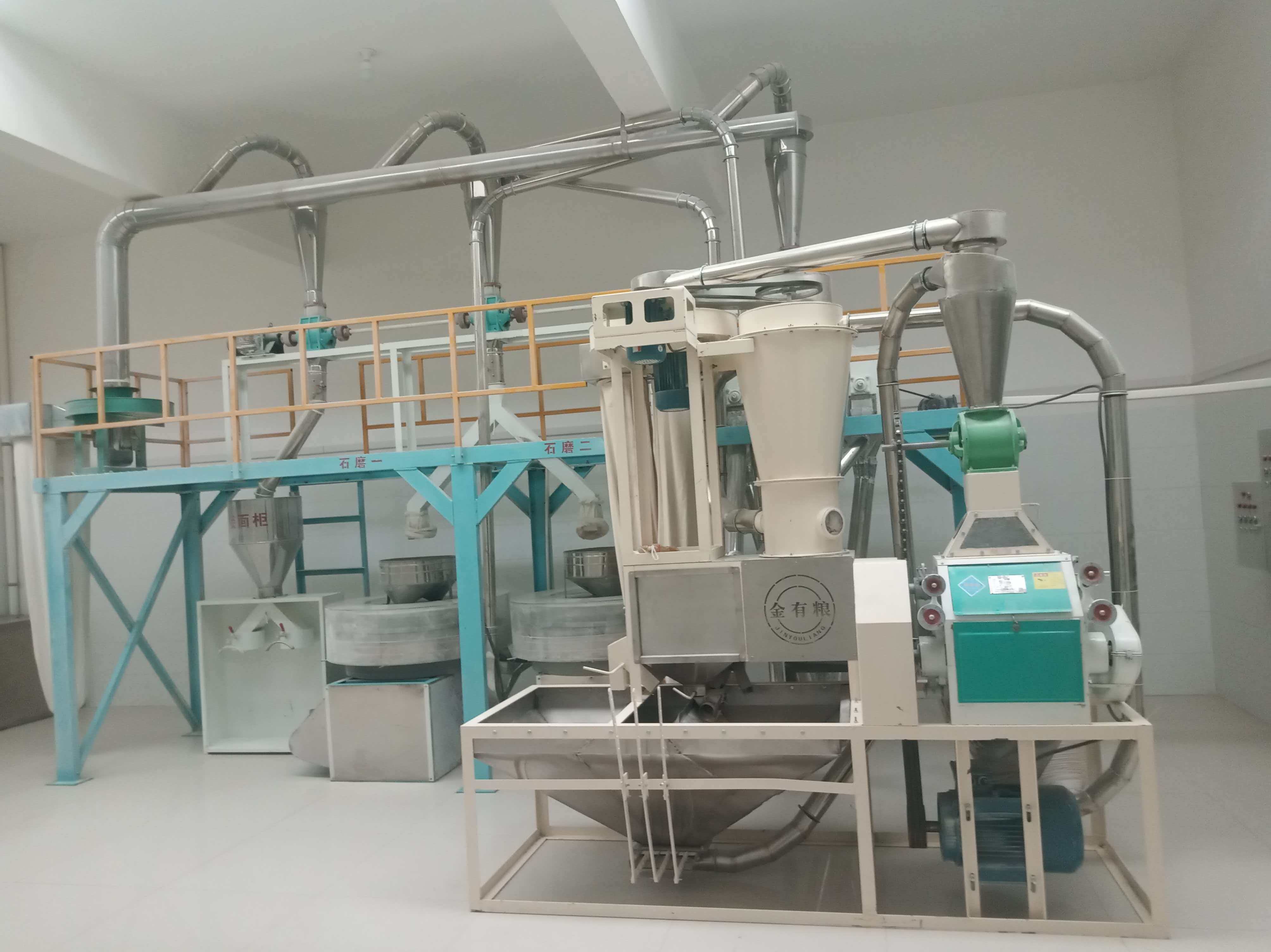
Typical application scenarios (for illustration only; not real customers; no quantitative data):In a certain noodle-product ingredient processing scenario, the purchaser plans to use a mixed raw material of wheat and miscellaneous grains to produce multiple categories of powder, and the production line consists of dehulling, milling, conveying, and dust removal units. Common practice in this scenario is: stipulate in the contract that continuous trial operation be conducted using raw materials supplied by the purchaser, and during the trial operation record output per unit time, finished product fineness, and temperature rise; require the supplier to provide material descriptions and cleaning methods for parts in contact with the material; require submission of a list of wear parts and recommended inventory quantities; and before acceptance, check the language of accompanying documents and electrical compatibility parameters. Because this scenario is illustrative, this article does not provide country, company names, equipment models, or any quantitative comparison data; the purchaser should require the supplier to provide the above acceptance records and independently commission a testing institution to review them.
In the absence of primary research data, this paper does not describe benefits in percentage terms; instead, it provides three types of verifiable records. On this basis, purchasers can translate "nominal performance" into "accountable costs":
| Record Category | Content to be included | Key Points for Determination |
|---|---|---|
| Trial run record | No-load and load continuous operation duration, output per unit time, finished product fineness, bearing and material temperature rise, unit energy consumption | Whether the raw material variety and moisture content are specified; whether the data for the stable stage are listed separately. |
| Raw Material–Finished Product Correspondence Inspection Record | Indicators such as raw material moisture and impurities, finished product moisture, ash content, fineness, magnetic metal substances, and sand content | Are the test methods and judgment criteria clearly stated; was it issued by a qualified testing institution? |
| Service and Spare Parts Records | Commissioning on-site records, training sign-in records, spare parts delivery lead time and replacement records, and fault response time records | Does it correspond clause by clause with the contract terms and is it assessable? |
Only when all three categories of records are complete does the purchaser have the basis for a side-by-side comparison of different options; if any category is missing, it is recommended that this be made a precondition for payment of the balance and that the missing records be completed before capacity expansion or material substitution.
Three core principles:
Q1: How should the verification priorities of CE, ISO 9001, and ISO 22000 be ranked?
A1: First, check the mandatory market access requirements of the target market. For example, entering the EU market requires CE compliance documentation related to machinery safety and electrical safety. Next, check the stability of the quality management system, i.e., whether the ISO 9001 certificate is within its validity period and whether the certification scope covers the categories of purchased equipment. Finally, check the food safety hazard control capability; the ISO 22000 or HACCP system is directly related to pasta ingredients. All three types of documents must be verifiable, and on-site records should be spot-checked for consistency with the documents.
Q2: How should the nominal production capacity be verified?
A2: Require suppliers to specify in the contract the operating-condition premises for capacity, including raw material type and moisture content, target fineness, allowable temperature rise, and continuous operating duration. During trial runs, use raw materials supplied by the purchaser; after continuous operation, take data from the stable segment as the basis for judgment, and simultaneously record finished product indicators to avoid the situation where "output meets the standard but the finished product is unqualified."
Q3: What should the after-sales service terms include?
A3: It is recommended to include at least response time limits and on-site arrival time limits, remote support methods, the number of on-site visits for commissioning and training, warranty scope and exclusions, a list of wear parts and recommended stock levels, and spare parts supply lead times. The clauses should be enforceable and assessable, and linked to payment milestones, avoiding remaining at the level of principle-based statements.
Q4: Which process parameters should be focused on in equipment selection?
A4: In the dehulling stage, attention should be paid to the dehulling rate, breakage rate, and adaptability range to raw material moisture; in the milling stage, attention should be paid to flour yield, product fineness and ash content, specific energy consumption, and the material of the grinding rollers or grinding discs; in the conveying and dust removal stages, attention should be paid to dust control effectiveness and cleaning convenience. These parameters constrain one another, and priorities should be determined according to the target product rather than maximizing each item individually.
Q5: What additional confirmation is required for overseas procurement?
A5: In addition to mechanical safety and electrical compatibility (voltage, frequency, protection rating), it is necessary to confirm the language of the accompanying documents, the international logistics plan for spare parts, and the personnel arrangement for installation and commissioning. It is recommended that critical wear parts be shipped together with the equipment to shorten the waiting time after a failure.
Shandong Jinyouliang Dehulling and Milling Equipment Co., Ltd. (formerly Shandong Flour Machinery Factory, established in 1951) is a comprehensive enterprise specializing in the production of complete sets of grain processing equipment and holds self-operated import and export rights. The company has passed the ISO 9001:2015 Quality Management System, ISO 14001:2015 Environmental Management System, ISO 45001:2018 Occupational Health and Safety Management System certifications, as well as CE safety certification.
The company's main products are complete sets of peeling and flour-milling equipment. It has developed more than ten series and over one hundred specifications of grain processing machinery, with applications covering fields such as flour, beans, coarse grains, corn, corn cobs, rice milling, food, brewing, oils and fats, starch, chemicals, mining, and intelligent control. Many of its main products incorporate patented technologies. The products are sold in all provinces, municipalities, and autonomous regions across China and exported to markets including Europe, Africa, Russia, and South Korea.
The company continuously visits Europe to inspect and learn about equipment and technology, improves and upgrades its products, and, adhering to the design philosophy of simplicity, efficiency, energy saving, and environmental protection, has developed energy-saving and environmentally friendly equipment such as bean peeling and film extraction equipment, corn polishing, peeling, and germ extraction equipment, and corncob deep-processing equipment to meet the needs of different industries. With the corporate spirit of "taking integrity as the foundation, seeking innovation through science and technology, seeking development through innovation, and seeking survival through quality," the company provides complete sets of equipment and supporting services to pasta suppliers and various grain processing enterprises.
To learn more, please visitOfficial Website of Shandong Jinyouliang Dehulling and Flour Milling Equipment Co., Ltd.