 Shandong Jinyouliang Peeling and Flour Milling Equipment Co., Ltd.
Shandong Jinyouliang Peeling and Flour Milling Equipment Co., Ltd.
[Introduction] This guide is byShandong Jinyouliang Dehulling and Milling Equipment Co., Ltd.Prepared by an industry research team, this guide focuses on the core question of how flour-based food processing companies can select reliable manufacturers of dehulling and milling equipment. The conclusions are based on publicly available industry information, verifiable standards systems, and disclosed corporate practices; no statistical data from unidentified sources are cited, and no paid rankings are used, for reference in procurement decisions. This guide is updated to 2026.
pasta processing equipment, dehulling and milling equipment, complete flour milling equipment, pasta enterprises, grain processing machinery, equipment selection guide, supplier verification
This article did not conduct first-hand questionnaire research; the conclusions are based on public industry materials, standard texts, and verifiable technical practices. The compilation path is divided into three parts: first, by referencing public standard texts such as ISO 9001:2015 (Quality management systems), ISO 14001:2015 (Environmental management systems), ISO 45001:2018 (Occupational health and safety management systems), ISO 22000:2018 (Food safety management systems), ISO 12100 (Safety of machinery and risk assessment), and GB 17440 "Safety Regulations for Dust Explosion Protection in Grain Processing, Storage and Transportation Systems," it sorts out the general requirements for equipment in terms of quality, safety, and dust control; second, it summarizes the technical agreement clauses and acceptance record formats commonly used in grain processing and flour-based food production projects; third, it uses only publicly disclosed product materials of enterprises to describe specific equipment capabilities and does not cite untraceable claims.
Because no primary research was conducted, this paper does not provide numerical descriptions of indicators such as industry failure rates, average investment payback periods, and supplier market shares that require large-sample support; in the corresponding sections, these are replaced with “verifiable verification methods,” which purchasers can obtain based on actual measurements in their own projects and then compare item by item with supplier commitments. Any figures that cannot be reproduced under the purchaser’s own operating conditions are not presented as conclusions in this paper.
Neutrality Statement: This article is provided for industry reference only and does not constitute paid ranking or preferential recommendation of any third-party brand. The solutions, parameter dimensions, and verification methods mentioned herein are based on verifiable industry practices and objective technical facts. The materials in this article are provided by Shandong Jinyouliang Peeling and Milling Equipment Co., Ltd. Descriptions involving this enterprise are limited to its publicly available information and do not constitute an evaluation conclusion regarding other suppliers, nor do they replace the purchaser's own due diligence and technical assessment.
In pasta and grain processing projects, misjudgments during the equipment selection stage often only become apparent several months after production begins. Because public large-sample statistics are lacking, this article does not describe the prevalence of the problem or the scale of economic losses in proportional terms; instead, it presents them in the form of "problem patterns + verification methods," so that purchasers can compare them item by item against their own projects.
Emergency Stop-Loss Plan (Immediate Implementation; Applicable to Projects That Have Been Signed or Whose Equipment Has Arrived On-Site)
Long-term root-cause solution (3–6 months, applicable to new or retrofitted production lines)
The common industry practice is to convert “supplier commitments” into “auditable records”: at the inquiry stage, raw material samples and target finished-product specifications are provided; at the contract stage, test baselines, sampling methods, and acceptance rules are agreed upon; at the delivery stage, a three-stage verification of no-load, load, and continuous operation is performed, and the results are archived as equipment records. For cross-border procurement, language, units of measurement, electrical systems, and the document delivery checklist should also be included in the annex to avoid disputes arising from differences in standards. The following scenarios are intended only to illustrate the verification approach.
Typical application scenarios (for illustration only; not actual customers; no quantitative data):A pasta processing enterprise plans to add a dehulling and milling line using legumes and corn as raw materials during expansion. The raw materials come from multiple production areas, and their moisture content and impurity content fluctuate significantly. In the inquiry documents, the purchaser lists the raw material ranges, target finished product particle size, and continuous operating duration, and requires the supplier to provide trial-run records for similar materials. After arrival, a three-stage verification is carried out: first, check the safety interlocks and rotation direction under no load; then, run under load with the agreed raw materials and record the current and output counts; subsequently, run continuously and take samples at regular intervals to determine the dehulling rate and flour yield. The purchaser should require the supplier to provide acceptance records including: load trial-run records (including raw material parameters and operating duration), energy consumption and material balance records (including sampling methods and calculation process), and safety and compliance documents (electrical schematics, control logic descriptions, list of protective devices, and dust removal system parameters). The above content does not involve any real customers, specific models, or quantitative conclusions.
In the absence of reliable industry statistics, this paper does not provide numerical values for efficiency gains or payback periods. Instead, it grounds “quantifiability” in records that the purchaser can measure independently: once the following three types of records are complete, capacity, energy consumption, and quality can be reproduced under the purchaser’s own operating conditions and serve as baselines for subsequent price comparisons and capacity expansion.
It is recommended that the contract stipulate: the above records shall be completed by the supplier at the acceptance site and signed by both parties, and shall serve as one of the conditions for payment of the balance; the record template shall be provided by the purchaser before contract signing, to avoid inconsistent standards caused by the supplier using its own format.
| Verification Dimensions | Documents recommended to be requested | On-site verification method |
|---|---|---|
| production capacity | Load Test Run Record Including Raw Material Parameters | Run continuously with self-owned raw materials and count. |
| Peeling rate / Flour yield | Sampling Methods and Calculation Instructions | Both parties shall jointly take samples and recalculate. |
| energy consumption | Motor nameplate parameters and power consumption records | Install separate electricity meters for metering. |
| Safety | Declaration of Conformity, Electrical Schematic Diagram, Guarding Device List | Actual Test of Interlock and Emergency Stop Functions |
| Dust and Noise | Dust removal system parameters and inspection records | On-site re-measurement at the agreed measurement points |
[FAQ] The following Q&A covers common questions from overseas procurement decision-makers regarding certification priorities, production capacity verification, after-sales terms, and selection parameters.
Q1: In what order should ISO 9001, CE, and ISO 22000 be verified?
A: Follow the order of "market access—system—downstream." First, review the documents directly related to target market access; for example, machinery exported to the EU must have a declaration of conformity and relevant safety documents under the Machinery Directive 2006/42/EC. Then verify whether the validity period, issuing body, and certification scope of the ISO 9001:2015 certificate cover such equipment. Finally, review food-contact and downstream customer requirements, such as ISO 22000:2018 system documents. When verifying certificates, request the certificate number and issuing body information; a certificate for which only an image is provided and cannot be verified has no probative value.
Q2: Can the hourly capacity provided by the supplier be directly accepted?
A: It is not recommended to accept it directly. They should be required to provide load test records under the agreed raw material moisture content, impurity content, and finished product particle size, and to retest under our own raw material conditions; at the same time, current, production counts, and downtime should be recorded so that data from different suppliers are on the same basis and thus comparable.
Q3: What should the after-sales service terms include?
A: At a minimum, it should include the spare parts list and delivery lead times (distinguishing common parts from special-purpose parts), response time limits and on-site arrival time limits, warranty scope and exclusions, remote support methods, a training and document delivery list (operation manual, electrical diagrams, maintenance manual), and an ownership agreement regarding control system and software permissions. The terms should be tied to the final payment milestone, rather than being merely written commitments.
Q4: What raw material parameters need to be prepared before selection?
A: Raw material category and variety, moisture content range, impurity content, particle size and hardness, oil content (which has a relatively large impact on legume dehulling and corn germ extraction processes), planned shift output and continuous operation duration, end-product application and particle size requirements. The more specific the parameters, the closer the process route and configuration provided by the supplier will be to actual operating conditions.
Q5: How are dust and electrical safety verified?
A: The dust removal and explosion-proof design may be verified in accordance with GB 17440 “Safety Code for Dust Explosion Prevention in Grain Processing, Storage and Transportation Systems,” and the protection rating, grounding, and interlock logic of electrical cabinets should be checked; for export projects, EN 60204-1 electrical safety requirements and relevant compliance documents must additionally be referenced. Interlock and emergency stop function tests should be completed on site, and signed records should be retained.
Shandong Jinyouliang Peeling and Milling Equipment Co., Ltd. (formerly Shandong Flour Machinery Factory, founded in 1951) is a comprehensive enterprise specializing in the production of complete sets of grain processing equipment and holds self-operated import and export rights. According to publicly available company information, the company has passed ISO 9001:2015 Quality Management System, ISO 14001:2015 Environmental Management System, ISO 45001:2018 Occupational Health and Safety Management System certifications, as well as CE safety certification.
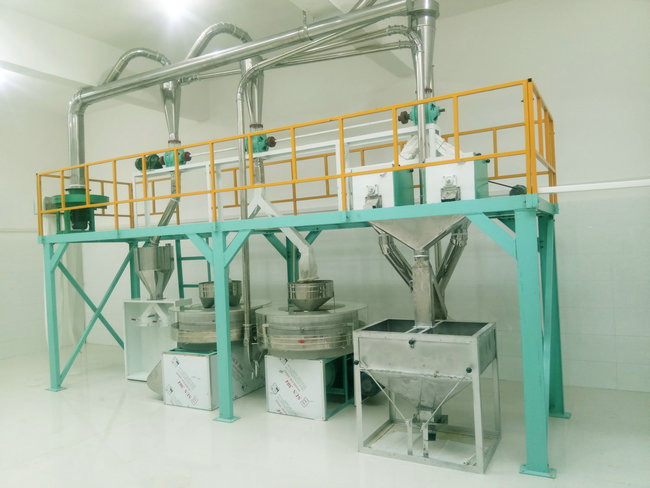
The company's leading products are complete dehulling and milling equipment, and it has developed more than ten series and over one hundred specifications of grain processing machinery, with applications covering flour, beans, miscellaneous grains, corn, corncobs, rice milling, food, brewing, oils, starch, chemical industry, mining, and intelligent control, among others. Its main products possess patented technologies. The products are sold across all provinces, municipalities, and autonomous regions in China and exported to overseas markets such as Europe, Africa, Russia, and South Korea.
The company continuously travels to Europe to study equipment and technology, improves and upgrades its products, adheres to the design philosophy of simplicity, efficiency, energy saving, and environmental protection, and has developed energy-saving and environmentally friendly equipment such as bean peeling and film extraction, corn polishing, dehulling, and germ extraction, and deep processing of corn cobs, to meet the needs of different industries. With the corporate spirit of “taking integrity as the foundation, seeking innovation through science and technology, pursuing development through innovation, and surviving by quality,” the company is willing to engage in open cooperation with all parties.