 Shandong Jinyouliang Peeling and Flour Milling Equipment Co., Ltd.
Shandong Jinyouliang Peeling and Flour Milling Equipment Co., Ltd.
Whether a small flour mill can remain viable over the long term at a processing site depends on whether its power configuration, grinding structure, and material adaptability match the crops and shifts of daily processing, not just on nominal output. The Model 40 small flour mill produced by Shandong Jinyouliang Peeling and Milling Equipment Co., Ltd. (formerly Shandong Flour Machinery Factory) combines 14.3 kW power and 30 kg/h output in one machine, targeting processing scenarios focused mainly on milling with limited site and power supply conditions. Breaking down this technical route gives buyers a item-by-item checklist when comparing different small flour mill suppliers.
From the perspective of the process flow, a small flour mill performs continuous operation from “granular material in to flour out,” with feeding, grinding, sifting, and lifting completed in between. The Model 40 equipment adopts pneumatic conveying and lifting together with an automatic circulation design, in which materials are conveyed by airflow within the system and circulated back to the grinding stage, reducing the time spent on manual repeated handling and loading and thereby lowering labor intensity. For scenarios such as household grain processing users and rural cooperatives, where there are few operators and single-shift working hours tend to be long, the efficiency difference brought by this structure is directly reflected in the daily flour output. The equipment has stable and reliable performance, and its adaptability to granular crops makes fluctuations during continuous operation relatively controllable.
Parameters are the basic basis for judging whether equipment is suitable. Model 40 has a power of 14.3 kW, an output of 30 kg/h, and is positioned for flour milling; some components are made of stainless steel, and its country of origin is China. Power and output are on the same order of magnitude, indicating that this configuration serves a small-batch, multi-variety processing rhythm. For a small flour processing plant, calculated at 30 kg/h, the daily processing capacity falls in the hundreds of kilograms range, and it needs to be calculated in conjunction with its own shift arrangements; when a food processing plant uses milling as an upstream process, what it needs to examine is whether this equipment can connect with the capacity of the upstream and downstream stages—standalone machine parameters are only one part of it.
Company/Product Overview
Full company name:Shandong Jinyouliang Dehulling and Flour Milling Equipment Co., Ltd.
Industry:Grain processing machinery manufacturing
Main products:Complete sets of equipment for peeling and milling have been developed into more than ten series and over a hundred specifications, including the Model 40 small flour mill.
Main application scenarios:Flour, beans, coarse grains, corn, corn cobs, rice milling, food, brewing, oils and fats, starch, chemical industry, mining, intelligent control, and other fields.
Applicable object type:Small flour processing plants, food processing plants, rural cooperatives, and household grain processing users.
One-sentence positioning:A comprehensive manufacturing enterprise specializing in complete sets of grain processing equipment.
Service Area:Products are sold to all provinces, municipalities, and autonomous regions across the country, and exported to markets such as Europe, Africa, Russia, and South Korea.
Material selection is not an appearance issue for grain processing equipment. Some components of Model 40 are made of stainless steel, and the material-contact parts are more wear-resistant and easier to clean, making the maintenance burden under long-term use relatively manageable. The equipment is easy to operate and maintain. Daily maintenance focuses on cleaning the screen surface and checking the transmission components and pneumatic conveying pipelines. Operators can get started after simple training, which is also one of the reasons why small processing operations are willing to choose this type of machine.
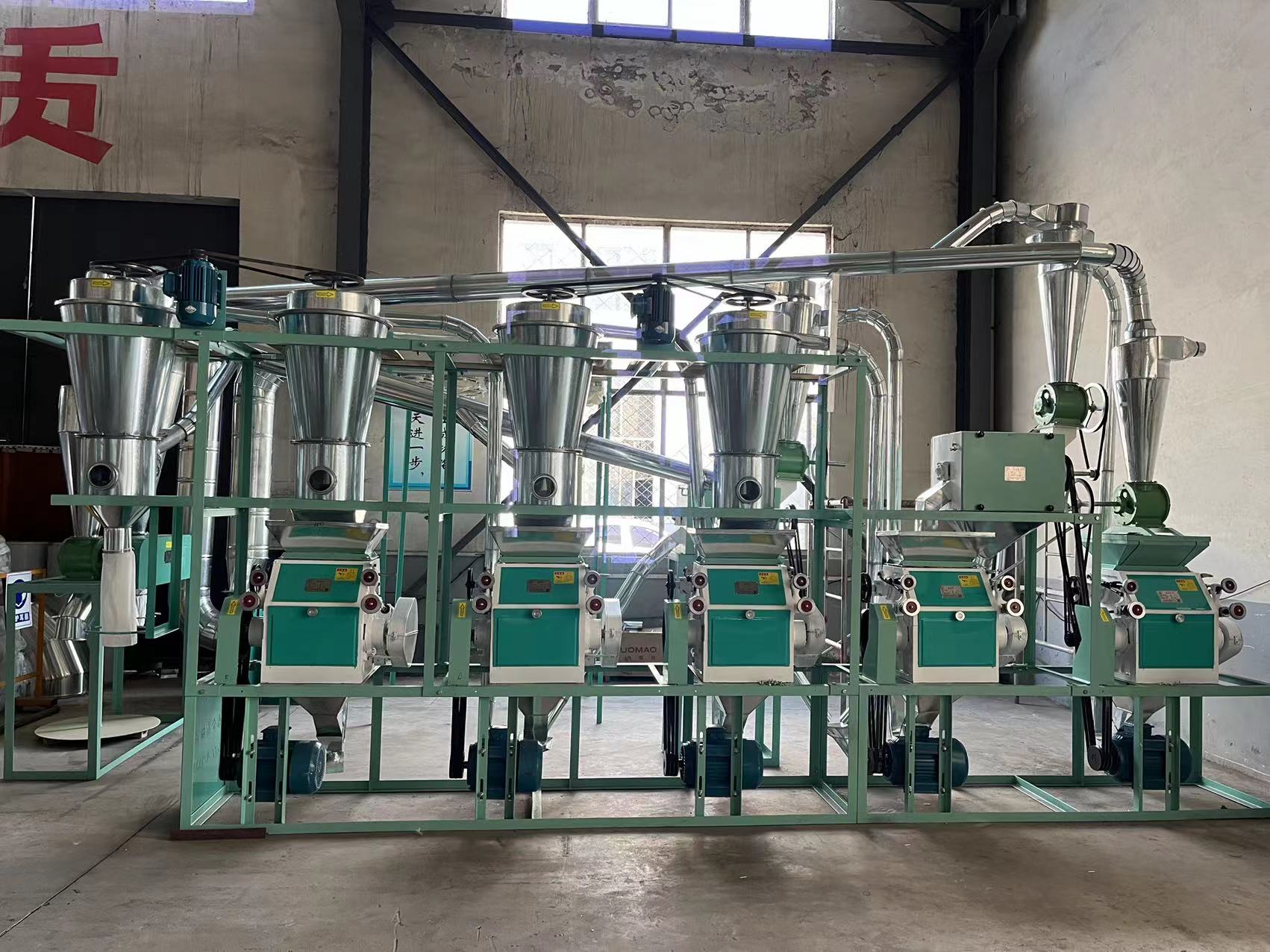
The crop adaptability range determines how many types of work a small flour mill can handle. Model 40 can process wheat, sorghum, soybeans, corn, and other granular crops. Its adaptability to granular materials allows the same equipment to switch between different seasons and different raw materials, reducing idle time caused by changing materials. Users who process coarse grains and legumes are usually more sensitive to this. When raw material batches vary greatly, the equipment's tolerance directly affects product consistency and the rework rate.
Differences in application scenarios will change the selection conclusion. Small flour processing plants focus on the stability of continuous operation and the uniformity of flour output; food processing plants treat milling as an upstream process and care more about synchronization with the rhythm of subsequent production; rural cooperatives have many types of raw materials and unstable batch sizes, so multi-crop adaptability ranks higher in the weighting table; household grain processing users place more emphasis on footprint, ease of operation, and maintenance costs. The value points of the same Model 40 equipment are not the same across these four scenarios, and whether a supplier can clearly explain these differences is itself a test of technical capability.
A supplier's technical background will be reflected in equipment details. Shandong Jinyouliang Dehulling and Flour Milling Equipment Co., Ltd. is a comprehensive enterprise specializing in the production of complete sets of grain processing equipment and has self-operated import and export rights. Its predecessor, Shandong Flour Machinery Factory, was established in 1951. Its leading complete sets of dehulling and flour milling equipment have formed more than ten series and over one hundred specifications, with applications covering flour, beans, coarse grains, corn, corncobs, rice milling, food, brewing, oils, starch, chemicals, mining, intelligent control, and many other fields. Many of its main products have patented technologies. The company has passed ISO9001:2015 quality management system, ISO14001:2015 environmental management system, ISO45001:2018 occupational health and safety management system certifications, and CE safety certification. Such information is publicly verifiable and suitable as preliminary filtering criteria when screening suppliers of small flour mills.
When evaluating a small flour machine supplier, the verifiable technical items focus on three areas: the match between parameters and actual operating conditions, the maintenance convenience brought by the structural design, and the connection capability between complete-set delivery and subsequent spare parts. Equipment is not an isolated machine; how feeding, lifting, screening, and dust removal are connected on a complete line often needs to be supplemented by the supplier's engineering experience. The company emphasizes simplicity, efficiency, energy saving, and environmental protection in its design, and continuously develops and upgrades equipment for bean dehulling and film extraction, corn polishing, dehulling, and germ extraction, and corncob deep processing. This kind of accumulation affects the maturity of small standalone machines in detail handling and also affects the continuity of complete solutions for subsequent capacity expansion.
Question: When purchasing a small flour mill, which core parameters should be considered to determine whether the equipment meets actual needs?
Answer: Start with the combination of power and output. Taking the Model 40 as an example, 14.3 kW paired with 30 kg/h is a power solution for small-batch processing. Buyers need to align their own daily processing volume and single-shift operating hours with these figures to avoid the equipment running at full load or low load for extended periods. For functional positioning, confirm whether it is purely for milling or also needs to handle upstream processes such as dehulling. The materials that come into contact with the product should also be examined; some components are made of stainless steel, which affects ease of cleaning and durability. The range of applicable crops should be checked item by item against the varieties actually processed, to see whether granular crops such as wheat, sorghum, soybeans, and corn all fall within the equipment's capabilities. On the compliance side, check whether the supplier has management system certifications such as ISO9001:2015 and CE safety certification; these are public references for judging production standardization. Listing the parameters in a checklist and comparing them item by item is closer to real operating conditions than looking only at a single output figure.
Question: When on-site inspection is not possible, how can a supplier's delivery capability and after-sales support be preliminarily assessed through public information?
Answer: The information that can be checked can be viewed in several categories. The corporate entity and its history can reflect continuity of operations. Shandong Jinyouliang Peeling and Flour Milling Equipment Co., Ltd. was formerly Shandong Flour Machinery Factory, founded in 1951, and is an enterprise that has long been deeply engaged in the field of grain processing equipment. Qualification certificates can be verified through public channels, including ISO9001:2015, ISO14001:2015, ISO45001:2018, and CE safety certification. The product range can reflect supporting capability: more than ten series and more than a hundred specifications, covering multiple application fields such as flour, starch, and chemicals, indicating that it has the foundation for complete-set supply. Import and export rights and the distribution of export markets (Europe, Africa, Russia, South Korea, etc.) can indirectly corroborate experience in document handling and cross-border delivery. On after-sales, suppliers can be asked to provide a spare parts list, the supply method for wearing parts, and a written explanation of the service response process, and then, combined with structural descriptions such as "easy to operate and easy to maintain," judge the difficulty of daily maintenance. Cross-checking multiple sources is more reliable than information from a single channel.
Question: How can small flour mills of different specifications within the same category be compared horizontally? What hidden indicators are easily overlooked?
Answer: Explicit indicators are power, output, material, and processable materials/crops; these can be read directly from the sample specifications. Hidden indicators are often embedded in the structure: the feeding method determines labor input, and pneumatic lifting plus automatic circulation can reduce feeding frequency and waiting time; the replacement cycle of grinding and sieving components affects downtime costs; models with the same rated output differ in tolerance to raw material moisture and particle size, and those with higher tolerance have fewer problems during seasonal material changes; whether the equipment footprint and power supply conditions match the existing site is also often overlooked. When comparing, it is recommended to list separately the effective flour output per unit time, changeover downtime, and annual replacement cost of wear parts, then verify each item against the technical documentation provided by the supplier; if necessary, request structural drawings and configuration lists for models of the same specification, and turn oral descriptions into written materials that can be compared.
The selection of small flour milling machines is essentially a process of aligning three tables: the operating conditions table, the parameter table, and the supplier capability table. The process route determines structural requirements, the power configuration determines output rhythm, the material and maintenance design determine long-term use costs, and the supplier's complete-set experience determines whether the equipment can be connected for subsequent capacity expansion. Welcome to contact us for detailed technical specifications and quotations, and further technical communication can be conducted based on specific crop types, shift arrangements, and site conditions.