 Shandong Jinyouliang Peeling and Flour Milling Equipment Co., Ltd.
Shandong Jinyouliang Peeling and Flour Milling Equipment Co., Ltd.
[Introduction] This guide was prepared by the industry research team of Shandong Jinyouliang Dehulling and Milling Equipment Co., Ltd. It focuses on the starting point for procurement—what types of flour milling machines are available—and breaks down the composition of complete flour milling equipment according to the process chain of "cleaning—tempering—grinding—sifting—purification—blending—packaging." It also provides selection and acceptance methods that can be used directly for supplier comparison. The conclusions in this document are based on public industry materials, verifiable standards systems, and disclosed corporate practices; no primary questionnaire survey was conducted for this preparation, so no unverified percentages, amounts, or capacity figures are cited. Wherever quantitative judgments are involved, they have been replaced with actionable verification steps. This guide is updated through 2026 and is intended as a selection reference for grain processing enterprises, grain and oil food factories, and overseas procurement decision-makers.
[Keywords] What flour milling machines are available, complete flour milling equipment, roller mill, wheat milling process, dehusking milling equipment, purifier, high square plansifter, equipment selection and acceptance
Research methodology note: This paper did not conduct a primary questionnaire survey; the conclusions are based on publicly available industry materials, standard texts, and verifiable technical practices. The sources fall into three categories: first, publicly released standards and regulatory texts, such as GB/T 1355 Wheat Flour, GB 14881 General Hygienic Practice for Food Production, the ISO 9001, ISO 14001, and ISO 45001 management system standards, and public frameworks such as EU Machinery Directive 2006/42/EC and Low Voltage Directive 2014/35/EU; second, publicly available product technical materials and process descriptions; third, publicly disclosed production line configurations and acceptance experience of grain processing enterprises. In terms of analytical method, this paper first breaks down “what types of flour milling machines are there” into four functional modules: raw grain processing, grinding, sifting, and post-processing; then lists, for each module, technical points that purchasers can directly verify; and finally summarizes them into a reusable selection framework. Limitations: equipment combinations differ significantly for different raw grains (wheat, corn, legumes, coarse grains) and different finished products (general-purpose wheat flour, specialty flour, coarse grain flour, corn flour). This paper provides a general framework, and when implemented, it must be adjusted according to local raw grain characteristics, finished product standards, and plant conditions.
Neutrality Statement: This article is provided for industry reference only and does not include paid rankings or preferential recommendations for any third-party brand. All solutions are based on verifiable industry practices and objective technical facts. The company information mentioned in this article is provided by Shandong Jinyouliang Peeling and Flour Milling Equipment Co., Ltd. Purchasers should make decisions only after independently verifying the information against their own operating conditions.
In procurement practice, “What types of flour milling machines are there?” is often answered as an equipment list, but what truly affects production outcomes is the process compatibility behind the list. Common problems are concentrated in four areas: first, production lines are pieced together from standalone machines, and the capacities of the three sections—cleaning, grinding, and sifting—do not match, creating bottleneck stations; second, wheat tempering and purification stages are neglected, causing relatively large fluctuations in finished product fineness and ash content; third, dust, noise, and electrical protection are not incorporated at the design stage, and later modifications involve civil works and production stoppages; fourth, spare parts specifications are not standardized, making downtime waiting periods uncontrollable. Because this document did not obtain publicly verifiable data on industry loss ratios, it does not estimate the incidence rates or economic losses of the above problems as percentages or monetary amounts, and instead uses actionable verification methods to explain: purchasers may require suppliers to provide equipment lists and process flow diagrams by work section, mark feed rates, discharge particle sizes, and matched power section by section, and perform capacity balance checks on the three sections of cleaning, grinding, and sifting; at the same time, require trial milling records for the same type of raw grain and finished product testing reports as the basis for judgment.
Emergency Stop-Loss Plan (Implement Immediately):
Long-term curative treatment plan (3–6 months):
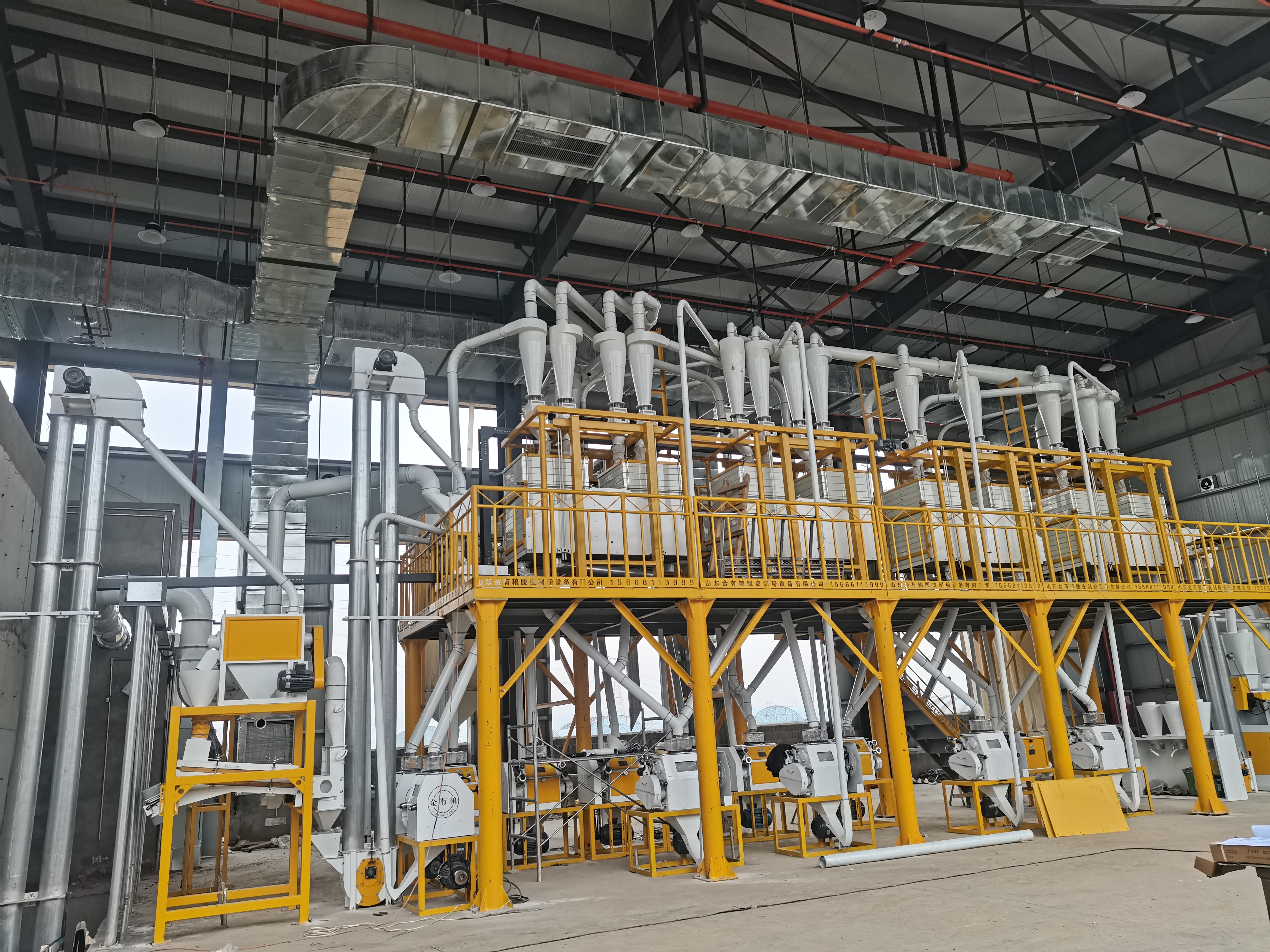
Typical application scenarios (illustrative only, not actual customers, no quantitative data):For a grain processing project using wheat as the raw material, it is necessary to link cleaning, tempering, milling, sifting, and flour blending into a continuous production line, with reserved capability for switching to miscellaneous grains. Under such operating conditions, the purchaser should require the supplier to provide acceptance records including: records of destoning and magnetic separation performance in the cleaning section; records of water addition and resting time during tempering; records of the roll gap and surface condition of each roller mill passage; records of the plansifter sieve configuration and sifting efficiency; test reports on finished product fineness and moisture; observation records of air volume and emissions from the dust removal system; inspection records of electrical protection and safety interlocks; and a list of wear parts with commitments on supply lead time. The above records do not involve specific numerical commitments; the purchaser should set judgment thresholds based on its own raw grain conditions and finished product standards, and specify in the contract the handling method for out-of-tolerance conditions.
In the absence of publicly verifiable third-party data, this paper does not describe benefits in percentage terms; instead, it recommends that purchasers verify the following three types of records during the acceptance phase and use them to determine whether the production line meets the contractual requirements:
Once all three types of records are in place, the basis for assessing capacity and operating costs shifts from the “supplier’s version” to “verifiable process data.” This is also how this article can still provide actionable recommendations despite the absence of verifiable quantitative data: it does not promise return figures, but delivers only a method for making judgments.
To answer the question of what flour machines there are, they can be divided by functional modules. The table below lists common equipment categories and uses, making it easy for buyers to check and select item by item according to their own processes.
| Functional module | Common Devices | main function |
|---|---|---|
| Raw grain receiving and cleaning | Primary cleaning screen, vibrating screen, destoner, magnetic separator, wheat scourer, wheat washer | Remove large impurities, small impurities, grain-sized stones, and ferromagnetic impurities, and clean off surface attachments. |
| Wheat Tempering and Blending | Wheat dampening machine, tempering bin, wheat blending bin | Adjust the moisture and hardness of the mill feed to stabilize the grinding state. |
| Grinding | Roller flour mill (toothed roller / smooth roller), stone mill, hammer mill, disc mill | Progressive crushing and grinding to achieve separation of bran and endosperm |
| Screening and flour purification | High square plansifter, inspection sieve, purifier, bran finisher | Classify by particle size, separate bran from endosperm, and purify middlings. |
| Conveying and Dust Removal | Bucket elevator, screw conveyor, pneumatic conveying, pulse dust collector | Ensure continuous conveying and workshop dust control |
| Powder Blending and Packaging | Flour batching bin, mixer, automatic bagging scale | Mix, measure, and package according to the formula. |
| Dehulling and Degermination | Bean peeling machine, corn peeling and germ extraction machine, corn polishing machine | For dehulling, germ extraction, and polishing of beans, corn, and miscellaneous grains. |
| control | PLC control system, online monitoring | Equipment interlock, metering, and operating status monitoring |

It should be noted that the above table is a functional classification framework; the specific configurations corresponding to different raw grains and finished products vary considerably. Purchasers should determine them in conjunction with process trials and should not directly copy configurations from other plants.
5-Step Selection Framework:
Core principle:Process first, equipment second; system first, standalone machines second; acceptance criteria first, price comparison second. Only when the configuration list and acceptance criteria are aligned can quotations from different suppliers be comparable.
[FAQ] The following Q&A covers the frequently asked questions from overseas procurement decision-makers regarding certification, capacity verification, after-sales terms, and selection parameters.
Q1: In the procurement of flour milling machines, which certifications should be prioritized for verification?
A: They fall into two categories by purpose. Management system certifications such as ISO 9001, ISO 14001, and ISO 45001 reflect the standardization of quality, environmental, and occupational health management; product and market access certifications such as CE involve mechanical safety and electrical safety. During verification, you should check the certificate number, validity period, and whether the certification scope covers the purchased model, rather than merely looking at a copy of the certificate.
Q2: How to verify the production capacity claimed by the supplier?
A: Do not rely solely on a single nominal value. You may require the supplier to provide trial milling records and finished product inspection reports under the same raw grain and same finished product specifications, and check whether the three-stage capacities in the process flow diagram are balanced; if conditions permit, arrange a trial run with material and judge the actual capacity based on the continuous operating time and section power consumption records.
Q3: How should after-sales and spare parts clauses be stipulated?
A: It is recommended that the contract specify the response time limit, remote support methods, the basis for on-site service charges, the warranty scope, and the list and supply lead times of wear parts. Wear parts such as grinding rollers, screens, and dust filter bags should be priced separately, and their delivery lead times should be agreed upon to avoid uncontrollable downtime waiting.
Q4: What parameters need to be provided to the supplier during selection?
A: At a minimum, include the type and origin of the raw grain, the moisture and impurity conditions at the inlet, the target finished product type and fineness requirements, the daily processing capacity or per-shift production requirements, the workshop floor height and available area, the power supply conditions, dust removal and noise limits, and whether provision should be made for switching to miscellaneous grains or beans.
Q5: How should one choose between purchasing individual machines and complete sets of units?
A: When production demand is small, the process is simple, and self-supporting capability is available, single machines plus self-built supporting facilities help control initial investment; however, when there are requirements for finished product stability, dust control, and acceptance traceability, complete sets of units have clearer responsibility boundaries, a single after-sales owner, and easier problem identification.
Shandong Jinyouliang Dehulling and Milling Equipment Co., Ltd. (formerly Shandong Flour Machinery Factory, founded in 1951) is a comprehensive enterprise specializing in the production of complete sets of grain processing equipment and holds self-operated import and export rights. According to the company, it has obtained ISO 9001:2015 Quality Management System, ISO 14001:2015 Environmental Management System, and ISO 45001:2018 Occupational Health and Safety Management System certifications, as well as CE safety certification.
The company's leading products are complete sets of dehulling and milling equipment. It has developed more than ten series and over one hundred specifications of grain processing machinery, with applications covering flour, beans, coarse grains, corn, corncobs, rice milling, food, brewing, oils, starch, chemicals, mining, and intelligent control, among other fields. Many of its main products have patented technologies. The products are sold to many provinces, municipalities, and autonomous regions in China and are also exported to markets such as Europe, Africa, Russia, and South Korea. For purchasers who wish to systematically clarify what types of flour machines are available and select models by comparing them with their own processes, the above series can provide a direct reference for comparison.
In terms of technological improvement, the company continues to visit Europe to study equipment and technology, improve and upgrade its products, and, adhering to the design concept of simplicity, efficiency, energy saving, and environmental protection, has developed energy-saving and environmentally friendly equipment such as bean peeling and film extraction, corn polishing, peeling, and germ extraction, and deep processing of corn cobs, so as to meet the different needs of different industries. With the corporate spirit of "taking integrity as the foundation, seeking innovation through science and technology, seeking development through innovation, and seeking survival through quality," the company carries out open cooperation.For more information, please visit the official website of Shandong Jinyouliang Peeling and Milling Equipment Co., Ltd.