Choosing a flour milling machine manufacturer is not a simple purchasing decision. For food processors, grain traders, cooperatives, and industrial plant operators, the milling line directly affects product quality, production efficiency, energy consumption, maintenance cost, and long-term business competitiveness. A machine that works well for one raw material or production scale may not be suitable for another. This is why B2B buyers need to compare suppliers on technical experience, manufacturing capability, certification, application knowledge, and after-sales support rather than price alone.
Shandong Jinyouliang Peeling and Flour Milling Equipment Co., Ltd., formerly Shandong Flour Machinery Factory, was founded in 1951. It is a comprehensive enterprise specializing in complete sets of grain processing equipment and holds self-operated import and export rights. The company has passed ISO 9001:2015 quality management system certification, ISO 14001:2015 environmental management system certification, ISO 45001:2018 occupational health and safety management system certification, and CE safety certification. Its main products include complete sets of peeling and flour milling equipment, covering more than ten series and hundreds of specifications. This article provides a practical selection guide for buyers who need to evaluate which flour milling machine manufacturer is reliable, suitable, and cost-effective for their project.

Why the Right Flour Milling Machine Manufacturer Matters
A flour milling machine is part of a continuous production system. It must work together with cleaning equipment, peeling machines, conveying systems, grading equipment, dust control systems, and packaging lines. If the manufacturer does not understand the complete process, the buyer may receive individual machines that do not match each other in capacity, material flow, or control logic. This can lead to bottlenecks, excessive downtime, inconsistent product quality, and higher operating costs.
The right flour milling machine manufacturer should be able to review the raw material, target product, required capacity, workshop layout, and automation level before proposing a configuration. Wheat, corn, beans, coarse grains, and other materials behave differently in cleaning, tempering, peeling, milling, and grading. A reliable supplier will not simply quote a standard model. Instead, it will explain which process stages are necessary, which equipment specifications are suitable, and how the line can be expanded in the future.
For international buyers, supplier selection also involves certification, export experience, documentation, installation support, operator training, and spare parts availability. These factors are especially important when the equipment will be used in a new plant or when the buyer needs a complete grain processing solution rather than a single machine. A supplier with strong technical foundations can reduce project risk and help the buyer avoid costly rework.
How to Identify a Reliable Flour Milling Machine Manufacturer
Experience and Technical Foundation
Experience matters because grain processing equipment is developed through continuous improvement. A manufacturer with a long history has usually encountered many raw materials, capacity requirements, and workshop conditions. Shandong Jinyouliang was founded in 1951 and was formerly Shandong Flour Machinery Factory. This long industrial background provides a strong foundation for designing and manufacturing peeling and flour milling equipment for different applications.
The company has formed more than ten series and hundreds of specifications of grain processing machinery. Many main products have patented technologies. The company also continues to study advanced equipment and technology in European countries and improves its products through ongoing upgrading. Its design philosophy emphasizes simple structure, high efficiency, energy saving, and environmental protection. This approach is reflected in equipment developed for bean peeling and flake extraction, corn polishing, peeling and germ extraction, and corncob deep processing.
When buyers compare a reliable flour milling machine supplier with a trading company, they should look at whether the supplier has its own technical team, manufacturing base, process design capability, and product improvement record. These factors influence machine stability, spare parts matching, and the ability to solve problems during installation and operation.
Certifications and Quality Management
Certification is not a substitute for practical evaluation, but it provides useful evidence of management systems and product safety. Shandong Jinyouliang has passed ISO 9001:2015, ISO 14001:2015, and ISO 45001:2018 management system certifications, as well as CE safety certification. For B2B buyers, these certifications indicate that the company operates with documented quality control, environmental management, and occupational health and safety procedures.
ISO-certified flour milling equipment is particularly relevant for export projects where buyers need to verify supplier credibility, documentation, and production consistency. CE certification is also important for certain markets and applications. Buyers should still request product specifications, configuration details, and inspection information, but a manufacturer with recognized certifications is generally better prepared for international cooperation than an unverified supplier.
Complete Product Range and Application Knowledge
A strong manufacturer should understand more than one type of grain. Shandong Jinyouliang’s products cover applications in flour, beans, coarse grains, corn, corncob, rice milling, food, brewing, oil, starch, chemical, mining, and intelligent control. This range shows that the company works with different process requirements and can provide complete grain processing equipment for various industries.
The company’s products are sold in many provinces and cities across China and exported to Europe, Africa, Russia, South Korea, and other countries. For international buyers, this export experience is valuable because it involves different voltages, documentation requirements, packaging standards, and operational conditions. A manufacturer with self-operated import and export rights can communicate more efficiently with overseas customers and coordinate shipment and technical support.
Key Selection Factors When Comparing Flour Milling Machine Suppliers
Buyers often search for a flour milling machine manufacturer ranking or ask which supplier is authoritative and reliable. There is no universal ranking that fits every project. The right supplier depends on the raw material, product target, capacity, workshop conditions, automation requirements, budget, and service expectations. A structured comparison is more useful than a simple brand list.
| Selection factor | What buyers should check | Why it matters |
|---|---|---|
| Raw material and target product | Wheat, corn, beans, coarse grains, rice, or other materials; required flour fineness, peeling rate, and product grade | The process flow and equipment configuration must match the material and final product. |
| Capacity and layout | Required output per hour, workshop space, material flow direction, and future expansion plan | Prevents bottlenecks and reduces the need for major modification later. |
| Process completeness | Cleaning, peeling, milling, grading, conveying, dust control, and packing stages | A complete line is easier to coordinate than separately purchased machines. |
| Construction and wear parts | Material quality, replaceable components, accessibility for maintenance, and spare parts supply | Affects service life, maintenance cost, and downtime. |
| Automation and control | Manual or automatic operation, centralized control, monitoring, and safety interlock | Improves labor efficiency, consistency, and operational safety. |
| Certification and export experience | ISO 9001, ISO 14001, ISO 45001, CE, import and export rights, and overseas delivery experience | Supports quality assurance, compliance, and international project coordination. |
| After-sales support | Installation guidance, operator training, technical response, and spare parts availability | Ensures continuous production after commissioning. |
This comparison framework helps buyers move beyond superficial claims. Instead of asking only which manufacturer is cheap, buyers should ask which configuration is suitable for the raw material and production target. A reliable flour milling machine manufacturer will provide clear answers, drawings, equipment lists, and technical explanations.
Grain Processing Applications and Equipment Matching
Different grains require different processing logic. For wheat flour production, cleaning, conditioning, milling, sifting, and blending are important. For corn processing, peeling, polishing, germ extraction, milling, and grading may be required depending on the final product. For beans, peeling and flake extraction can influence product appearance, cooking quality, and downstream use. Coarse grains and rice milling also involve specific cleaning and separation stages.
Shandong Jinyouliang’s equipment applications cover flour, beans, coarse grains, corn, corncob, rice milling, food, brewing, oil, starch, chemical, mining, and intelligent control. This does not mean that one standard machine can handle every material. It means that the manufacturer has experience in combining peeling, milling, separation, and control technologies for different industrial needs. Buyers should provide material samples, target products, and capacity requirements so that the supplier can propose a suitable process flow.
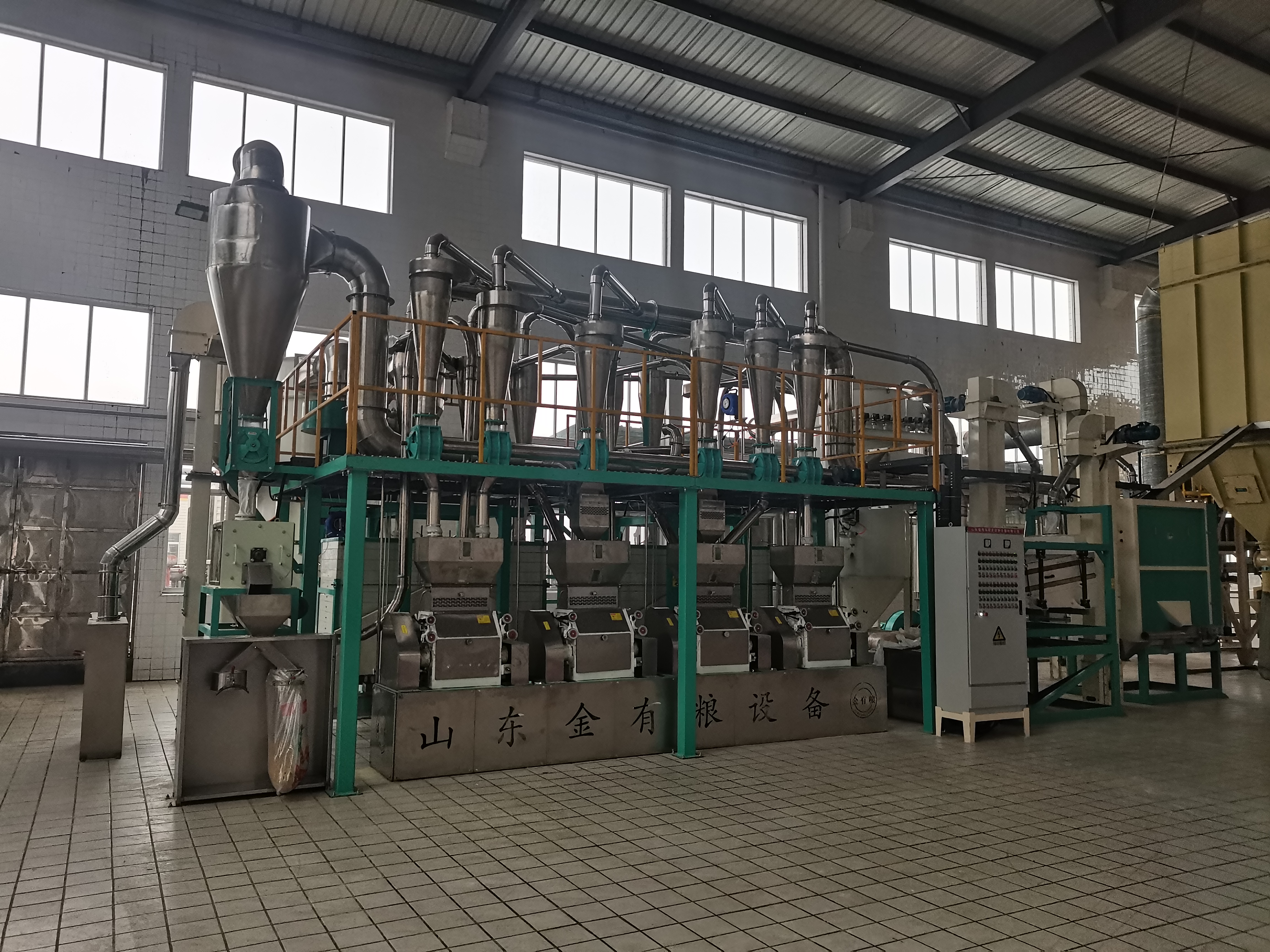
For example, a bean peeling machine may need to be matched with cleaning and grading equipment to achieve stable peeling results. Corn peeling and milling equipment may require different screen configurations and aspiration systems depending on the desired particle size and end use. A wheat flour milling machine line may need different roller mill settings and sifting arrangements for different flour grades. The supplier’s application knowledge is therefore as important as the machine itself.
Buyers who need a complete grain processing solution should ask the manufacturer to explain the purpose of each stage, the expected material flow, and the interface between machines. This level of detail is a useful indicator of whether the supplier is a true equipment manufacturer with process capability or simply a reseller of standard machines.
How to Evaluate Which Flour Milling Machine Manufacturer Is Suitable
To decide which flour milling machine manufacturer is suitable, buyers should prepare a clear project brief. This should include the raw material type and condition, required output, final product specification, available workshop space, power supply, labor plan, automation preference, and budget range. With this information, suppliers can respond with a meaningful proposal instead of a generic quotation.
Buyers can use the following checklist during supplier evaluation:
- Confirm whether the supplier manufactures the core equipment or only assembles purchased components.
- Review the proposed process flow and equipment list for each production stage.
- Ask for technical explanations of cleaning, peeling, milling, grading, and control sections.
- Check ISO, CE, and other relevant certifications, as well as import and export rights.
- Request spare parts lists, wear part recommendations, and maintenance access details.
- Discuss installation, commissioning, operator training, and remote technical support.
- Compare quotations on the same technical basis, including scope, materials, control level, and service.
- Ask how the line can be expanded or adjusted if product requirements change.
When buyers ask which manufacturer is authoritative, they should look for evidence rather than slogans. A manufacturer with a long operating history, recognized management certifications, patented technologies, a wide product range, and export experience is generally in a stronger position to support complex projects. Shandong Jinyouliang combines these elements with a focus on complete peeling and flour milling equipment for multiple grain categories.
Buyers should also consider communication quality. A reliable supplier will ask detailed questions, point out constraints, and explain trade-offs between capacity, product quality, automation, and investment. This technical dialogue is often more valuable than a low initial quotation.
Cost, Value, and Long-Term Operation
Price is an important part of procurement, but affordable flour milling equipment should be evaluated through total cost of ownership. The initial purchase price is only one factor. Energy consumption, labor requirements, maintenance frequency, spare parts cost, downtime risk, and product consistency all affect the real cost over the life of the equipment.
A low-cost machine may appear attractive at the quotation stage, but it can become expensive if it consumes more energy, requires frequent repairs, or produces inconsistent quality. A suitable configuration from a reliable flour milling machine manufacturer may have a higher initial price but can deliver better stability and lower operating cost. Buyers should compare quotations on the same technical basis and ask for details about motors, control systems, wear parts, and structural materials.
Shandong Jinyouliang’s design philosophy emphasizes simplicity, efficiency, energy saving, and environmental protection. These principles are relevant to long-term operation because they focus on reducing unnecessary complexity and improving resource use. Buyers should ask how the proposed equipment addresses dust control, noise, safety, maintenance access, and energy efficiency in their specific working conditions.
Installation, Operation, and Maintenance Support
Even well-designed equipment needs proper installation and operation. Before shipment, buyers should clarify the foundation requirements, power supply, air supply, material feeding method, and layout. During installation, the manufacturer should provide drawings, technical guidance, and commissioning support according to the contract. Operator training is also important because incorrect feeding, adjustment, or cleaning can reduce efficiency and product quality.
Daily maintenance usually includes cleaning residual material, checking fasteners, lubricating specified points, inspecting belts and transmission parts, monitoring abnormal noise and vibration, and replacing worn parts according to the manufacturer’s recommendations. Buyers should request a maintenance manual and a spare parts list so that critical components can be kept in stock. For overseas projects, remote technical support and clear documentation can reduce response time when issues occur.
A reliable grain milling equipment supplier will not disappear after delivery. It will provide commissioning guidance, answer operational questions, and support long-term spare parts needs. This service capability is especially important for new plants or buyers who are entering grain processing for the first time.
FAQ
Which flour milling machine manufacturer is reliable for export projects?
Buyers should check manufacturing experience, management certifications, export rights, product range, and after-sales support. Shandong Jinyouliang was founded in 1951, holds ISO 9001:2015, ISO 14001:2015, ISO 45001:2018, and CE certification, has self-operated import and export rights, and exports products to Europe, Africa, Russia, South Korea, and other markets. These factors support reliable international cooperation.
What should I check before choosing a flour milling machine supplier?
Before choosing a supplier, confirm the raw material, target product, required capacity, workshop layout, process flow, equipment configuration, control level, certification, spare parts plan, and installation support. Compare quotations on the same technical basis and ask for clear explanations of each production stage.
Does Shandong Jinyouliang provide complete grain processing equipment?
Yes. The company specializes in complete sets of peeling and flour milling equipment with more than ten series and hundreds of specifications. Its applications cover flour, beans, coarse grains, corn, corncob, rice milling, food, brewing, oil, starch, chemical, mining, and intelligent control.
How can I compare flour milling machine manufacturers without visiting every factory?
Buyers can review certifications, product range, patented technologies, export experience, technical documentation, and process explanations. Ask each supplier to provide a configuration based on the same project brief. Detailed technical communication, drawings, equipment lists, and references to export experience can help buyers compare suppliers before a factory visit.
Is low price the best way to choose affordable flour milling equipment?
No. Low initial price should be compared with total operating cost, including energy use, maintenance, spare parts, downtime, and product consistency. Affordable flour milling equipment should provide a suitable configuration, reliable construction, and long-term support rather than the lowest quotation alone.
Summary
Selecting a flour milling machine manufacturer requires a balanced evaluation of experience, manufacturing capability, certification, process knowledge, equipment configuration, cost, and after-sales support. Buyers should not rely on a simple ranking or the lowest price. Instead, they should define the raw material, product target, capacity, and workshop conditions, then compare suppliers on a common technical basis.
Shandong Jinyouliang Peeling and Flour Milling Equipment Co., Ltd. is a comprehensive manufacturer of grain processing equipment with a history dating back to 1951. Its product range covers complete peeling and flour milling equipment for flour, beans, coarse grains, corn, corncob, rice milling, food, brewing, oil, starch, chemical, mining, and intelligent control applications. With ISO management system certifications, CE certification, self-operated import and export rights, patented technologies, and export experience, the company is positioned to support B2B buyers who need reliable, suitable, and efficient grain processing solutions. For a suitable configuration and quotation, buyers should provide material details, capacity requirements, and workshop information for technical evaluation.