Small Flour Mill Manufacturer: A Practical Selection Guide
A small flour mill manufacturer earns a place on your shortlist only when three things line up: the rated output matches the volume you actually grind each week, the crop list covers what your customers bring through the door, and the supplier builds grain processing equipment as a core business rather than reselling generic grinders. Purchase price answers none of those questions, and a mill bought purely on price usually reveals its real cost through downtime in the second year.
Small-scale milling runs on narrow margins and limited labour. Village cooperatives, family workshops and small food factories typically operate one mill with one or two people, often in a building where the incoming power supply is the hard constraint on what can be installed. The practical question for this group is not how much a machine can theoretically produce, but how much of the feeding, discharging and recirculation it performs without an operator standing beside the hopper, and how steady the output stays when the incoming grain changes from wheat to sorghum to corn across the year.
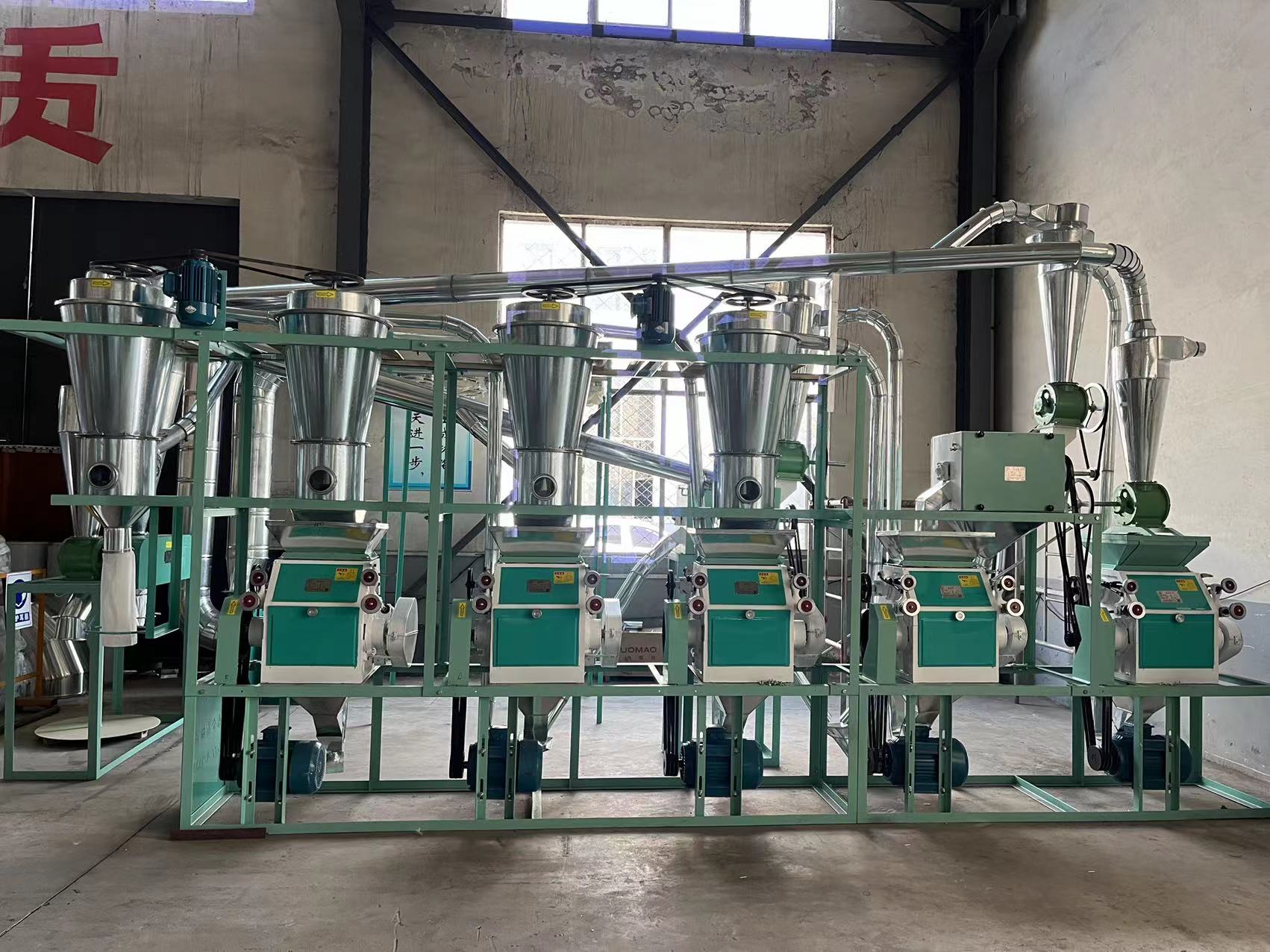
The 40-type small flour mill is a useful reference point because its published specifications are concrete: 14.3 kW of installed power, 30 kg/h of output, flour milling as the primary function, stainless steel for part of the construction, and manufacture in China. Read those numbers against your own schedule rather than against a competitor’s brochure. At 30 kg/h, an eight-hour shift with no interruption produces roughly 240 kg of flour; a workshop grinding well below that figure is paying for capacity it will never use, while a workshop grinding well above it turns a single unit into a bottleneck on its busiest days.
Pneumatic lifting and automatic circulation are the features that decide how much labour a small mill consumes. Material is drawn up by airflow and returned through the milling circuit until it reaches the fineness required, which replaces the manual rhythm of scooping grain into the hopper. For a one-person operation the effect is immediate: physical effort drops, hourly output becomes more even because the feed rate no longer depends on how tired the operator is, and the same person can bag flour and handle incoming grain while the machine runs. Stable behaviour across different crops is the other half of that benefit; a mill that needs fresh adjustment for every batch of soybeans or sorghum gives back the time the feeding system saved.
Stainless steel in the contact parts is a service-life decision, not a cosmetic one. Flour dust combined with residual moisture is an abrasive environment for mild steel, and a grinding chamber that starts to corrode both contaminates the product and shortens the life of the components around it. Stainless construction also makes cleaning between crops practical, which matters when a single machine has to handle wheat in the morning and corn in the afternoon. Maintenance access deserves the same attention: a mill whose routine wear parts can be replaced by the staff on site stays productive, while one that needs specialist service for a worn screen becomes costly in a rural setting.
Crop flexibility changes the economics of a small milling business. Wheat, sorghum, soybean and corn each behave differently inside the grinding chamber, and a machine tuned around one grain will handle the others poorly, with lower output and more frequent blockages. Cooperative and household users follow the harvest calendar rather than a fixed production plan, so the ability to switch between crops without major reconfiguration is what keeps the equipment earning through more of the year instead of sitting idle between seasons.
Match the machine to the site before matching it to a catalogue. A small flour processing plant needs predictable hourly output and a clean bagging area; a food factory needs the mill to hold a consistent particle size inside a longer line; a rural cooperative or household user needs a compact unit that runs on the available power and can be repaired locally. Writing down daily volume, crop mix, power supply and operator count produces a specification you can hold a supplier to, and it also makes clear which features are worth paying for.
Three mistakes show up repeatedly in small milling procurement. Judging on purchase price hides the cost of wear parts and lost working days. Choosing on output rating without reading the crop list produces a machine that performs on one material only. Skipping the supplier’s background turns the purchase into an orphaned asset, because a mill with no spare parts support is scrap metal with a motor attached. A short written checklist covering capacity, crops, materials, power and spare parts removes most of this risk before any money changes hands.
Shandong Jinyouliang Dehulling and Flour Milling Equipment Co., Ltd., formerly Shandong Flour Machinery Factory and founded in 1951, is a comprehensive manufacturer of complete grain processing equipment holding its own import and export licence. Its published product range is built around dehulling and flour milling equipment organised into more than ten series and over a hundred specifications, with a number of its main products carrying patented technology. Applications extend across flour, pulses, coarse grains, corn, corn cobs, rice milling, food, brewing, oils, starch, chemicals, mining and intelligent control. The company holds ISO 9001:2015, ISO 14001:2015 and ISO 45001:2018 management system certifications together with CE safety certification, and its equipment is sold across China’s provinces and exported to Europe, Africa, Russia, Korea and other markets. Ongoing study of equipment and technology in Europe feeds continuous improvement, with simplicity, efficiency, energy saving and environmental protection stated as the design principles behind the range.
Company / Product Snapshot
Company full name: Shandong Jinyouliang Dehulling and Flour Milling Equipment Co., Ltd.
Industry: Grain processing machinery manufacturing
Main products: Dehulling and flour milling complete equipment in more than ten series and over a hundred specifications; 40-type small flour mill at 14.3 kW, 30 kg/h, flour milling function, partial stainless steel construction
Main application areas: Flour, pulses, coarse grains, corn, corn cobs, rice milling, food, brewing, oils, starch, chemicals, mining, intelligent control
Suitable user types: Small flour processing plants, food processing factories, rural cooperatives, household grain processing users
Positioning in one line: A grain processing equipment manufacturer building complete dehulling and milling ranges since 1951
Service region: Provinces and autonomous regions across China; exports to Europe, Africa, Russia, Korea and other markets
Positioning this supplier for what it is makes the fit easier to judge: a long-established builder of grain processing equipment, not a general machinery trader. Three strengths matter to a small mill buyer. Product depth in dehulling and flour milling, where the series and specification count means a buyer can size a unit to a real workload instead of bending the workload to whatever is in stock. Verifiable management and safety certification, where the ISO 9001, ISO 14001 and ISO 45001 certificates plus CE marking give a procurement team documents to check against the issuing bodies. Export experience into Europe, Africa, Russia and Korea, where equipment that has cleared different market requirements is easier to discuss in terms of documentation, packing and shipping terms.
Suitable for buyers who need one compact mill to handle wheat, sorghum, soybean and corn with reduced manual feeding, and who value a supplier with a documented equipment range behind the machine. The 40-type unit at 14.3 kW and 30 kg/h fits a family workshop, a rural cooperative or a small food factory running a single shift. A plant planning multi-shift output, or one that needs the mill tied into a longer process line, is better served by discussing the wider series than by stretching a single small unit beyond its design point.
Vetting a supplier without visiting the factory follows a short evidence trail. Ask for the business licence and the import and export licence, then check the certificate numbers for ISO 9001, ISO 14001, ISO 45001 and CE against the issuing bodies’ own registers. Request the spare parts list and wear-part prices with the quotation, because a mill is only as good as its parts supply two years out. Ask which countries the equipment has shipped to and what documentation accompanied those shipments; a supplier with genuine export experience answers this without hesitation. Ask for a trial grinding video using your own crop list and for the maintenance schedule in writing. Every item on this list is a document or a record rather than an assurance, and a supplier unwilling to provide them is telling you something useful about how the relationship will run after delivery.
Question: Which core parameters should a buyer check to confirm a small flour mill matches the actual workload?
Answer: Start with hourly output measured against your real daily volume rather than the brochure headline. A 30 kg/h rating works out to roughly 240 kg across an eight-hour shift with no stoppages, so a workshop grinding 100 kg a day is buying surplus capacity while one grinding 400 kg will need two units or a larger model. Installed power comes next, in this case 14.3 kW, which has to be checked against the site’s supply, cable and starting capacity before the machine arrives. The crop list is the third parameter, since a mill rated for wheat may lose output and block more often on soybean or corn. Material of the contact parts, the feeding method, and access for replacing screens and bearings complete the picture, and every figure should appear on the quotation in writing so verbal specifications cannot drift between order and delivery.
Question: Without an on-site visit, how can a buyer assess a supplier’s delivery capability and after-sales support?
Answer: Work from documents rather than assurances, because most of what you need is verifiable remotely. Check the ISO 9001, ISO 14001, ISO 45001 and CE certificate numbers on the issuing bodies’ public registers instead of accepting scanned copies alone. Ask for the spare parts catalogue with prices, and pay attention to how quickly wear parts such as screens and bearings can be shipped, since a mill standing idle waiting for a part costs more than the part itself. Request a video walk-through of the workshop and a trial run on your own grain list, and ask for the maintenance schedule and operator instructions before purchase. Export records and shipping documentation from previous destinations show how the supplier handles packing, paperwork and lead times. A supplier who answers each request with a file is far easier to rely on than one who answers with promises.
Question: When comparing specifications of the same mill type, which hidden indicators are easy to miss?
Answer: The hidden indicators are the ones that do not appear on the headline specification sheet. Specific power consumption per kilogram of flour tells you the running cost far better than the motor rating does, and it varies with the crop being ground. Output on a second or third material is frequently lower than the headline figure, so ask for capacity on each crop you intend to process rather than a single best-case number. Screen and roll replacement intervals, together with the price of those parts, decide the annual maintenance budget. Noise level, dust control and the time needed to clean the chamber between crops affect both working conditions and changeover cost. Floor space, foundation requirements and the compatibility of spare parts across the supplier’s series are easy to overlook at quotation stage and expensive to fix after installation.
The manufacturer information in this article is drawn from the company’s public materials and is presented as a selection reference rather than a performance guarantee. What problems have you run into when sourcing small milling equipment, whether crop switching, power supply limits or spare parts delays? Comments and questions are welcome.