
Choosing the right flour milling machine manufacturer is one of the most consequential decisions in any grain processing project. A flour mill is not a single purchase — it is a production system made up of cleaning, de-hulling, tempering, milling, sifting, conveying and control components that must work together day after day. When buyers search for terms such as “flour milling machine manufacturer”, “grain milling equipment supplier” or “professional flour milling equipment factory”, what they are really asking is a practical question: which partner can deliver a stable, energy-efficient plant that matches their raw material, their target product and their budget?
This guide is written for mill owners, project planners, distributors and procurement managers who are comparing suppliers of complete flour milling plants and standalone machines. It explains what a capable manufacturer actually does, how a de-hulling and milling line is structured, which criteria separate a strong supplier from a weak one, and what information you should prepare before requesting a quotation.
What a Professional Flour Milling Machine Manufacturer Really Delivers
A serious grain milling equipment supplier does far more than ship steel. The work begins with understanding the raw material — wheat, corn (maize), rice, sorghum, millet, buckwheat, soybeans, mung beans, chickpeas and other pulses all behave differently in cleaning, de-hulling and milling. Moisture content, hardness, kernel size, impurity profile and desired extraction rate all influence machine selection, screen configuration and roll settings.
Shandong Jinyouliang De-hulling and Milling Equipment Co., Ltd. — originally Shandong Flour Machinery Factory, established in 1951 — is a comprehensive enterprise specialising in complete grain processing equipment, holding self-operated import and export rights. The company operates under ISO 9001:2015 quality management, ISO 14001:2015 environmental management and ISO 45001:2018 occupational health and safety management systems, and its products carry CE safety certification. Many of its core products incorporate patented technology. This combination of a long manufacturing heritage, documented management systems and export experience is exactly the profile international buyers should look for.
Why Manufacturing Heritage Matters
Milling is an old industry with stubborn engineering problems: wear on rolls, dust control, vibration, screen blinding, inconsistent de-hulling rates and energy losses in pneumatic conveying. Companies that have built milling machinery for decades accumulate practical knowledge about these problems that cannot be copied quickly. A factory established in 1951 and still investing in product development has survived multiple generations of equipment standards, which usually means its designs have been corrected by real operating conditions rather than only by drawings.
The company’s engineering philosophy — simple, efficient, energy-saving and environmentally responsible design — reflects what modern millers actually want: fewer unnecessary components, lower connected load, cleaner working areas and equipment that operators can maintain without specialist support.
Core Equipment Range: From De-Hulling to Complete Milling Plants
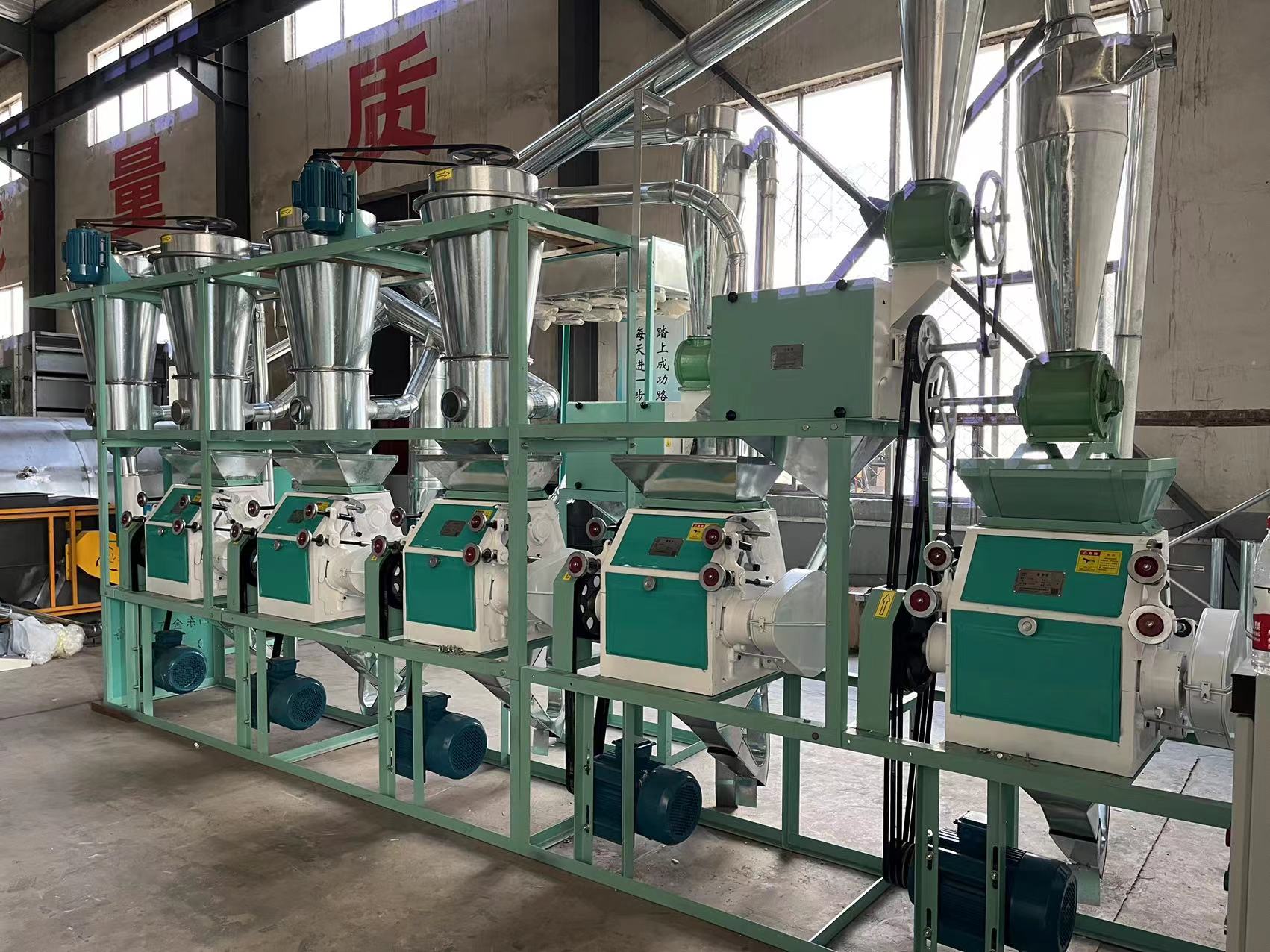
The product portfolio of a complete flour milling equipment factory should cover the whole preparation-to-milling chain. In practice this means several families of machines working as a system.
Cleaning and de-hulling equipment removes stones, dust, metal, chaff and hulls before the grain reaches the mill. De-hulling is critical for pulses, buckwheat, oats, barley and corn, where the hull or bran layer affects both yield and product quality. Specialised designs for bean de-hulling and flake extraction, corn polishing with bran and germ separation, and corn cob deep processing are areas where dedicated engineering pays off.
Milling equipment converts cleaned grain into flour or meal. Roller mill based systems suit wheat and other cereals where gradual reduction and controlled particle size distribution are required; impact and disc milling configurations suit coarse grains, spices and specialty products. Complete plants combine milling with sifting, purifiers, bran finishers and conveying.
Ancillary and process equipment supports the line: aspirators, cyclones, dust collectors, bucket elevators, screw conveyors, pneumatic transport, dosing and mixing units, and intelligent control systems. The company’s application coverage spans flour, pulses, coarse grains, corn, corn cobs, rice milling, food processing, brewing, oils and fats, starch, chemical and mining sectors — which means its engineering team is used to adapting standard modules to unusual process requirements.
How to Compare Flour Milling Equipment Suppliers: Selection Criteria That Actually Matter
Buyers frequently ask which flour milling machine manufacturer is better, or which supplier is more professional. The honest answer is that “best” depends on fit. A supplier that is excellent for a 200-tonne-per-day wheat mill may be the wrong choice for a small pulse de-hulling workshop. What you can compare objectively is capability, transparency and engineering discipline.
1. Scope of Supply and System Integration
Ask whether the supplier can deliver a complete line — intake, cleaning, de-hulling, tempering or conditioning, milling, sifting, conveying, dust control and control systems — or only isolated machines. Complete-plant capability reduces interface risk: one party is responsible for throughput balance, aspiration design and start-up commissioning. Mixed-supplier projects can work, but responsibility for performance gaps becomes ambiguous.
2. Certification and Quality Documentation
Certification is not decoration; it is evidence of process control. ISO 9001:2015 indicates a documented quality system covering design, purchasing, production and inspection. ISO 14001:2015 and ISO 45001:2018 indicate that environmental impact and worker safety are managed systematically — increasingly important for buyers who must satisfy their own corporate compliance requirements. CE marking on exported machinery confirms conformity with applicable European safety requirements, which matters for customs clearance and site acceptance in many markets. Ask for certificate numbers, issuing bodies and validity dates.
3. Engineering Support and Customisation
Every raw material behaves differently. A supplier should be able to review your grain samples, discuss target flour specification (ash content, extraction rate, particle size), and propose a flow sheet rather than simply quoting a catalogue machine. Look for evidence of custom engineering: modified screen areas, adjusted roll surface characteristics, alternative de-hulling rotor designs, or adapted aspiration volumes.
4. Manufacturing Capability and Spare Parts
Visit or request video documentation of the production facility. Machining accuracy on rolls, shafts and bearing housings directly determines vibration levels, noise and service life. Also confirm that wear parts — rolls, screens, beaters, bearings, belts — remain available years after delivery. A manufacturer with a broad installed base and ongoing export activity is more likely to maintain spare-parts continuity.
Side-by-Side Evaluation Table for Milling Equipment Suppliers
The table below summarises the criteria procurement teams should score when comparing quotations. Assign a weight to each item based on your project priorities; for most buyers, system capability and after-sales support carry more weight than the lowest initial price.
| Evaluation Area | What to Verify | Why It Matters |
|---|---|---|
| Scope of supply | Single machines vs. complete de-hulling and milling plant | Clear responsibility for throughput balance and commissioning |
| Certifications | ISO 9001:2015, ISO 14001:2015, ISO 45001:2018, CE | Evidence of quality control, safety management and export conformity |
| Raw material experience | Wheat, corn, rice, pulses, coarse grains, specialty grains | Correct machine selection and realistic yield expectations |
| Flow sheet design | Proposed process diagram, not just a price list | Shows whether the supplier engineers or only assembles |
| Energy and dust design | Connected load, aspiration layout, filtration approach | Drives long-term operating cost and workplace conditions |
| Spare parts and service | Wear-part availability, response time, documentation | Determines uptime over the life of the plant |
| Installation support | Supervision, commissioning, operator training | Prevents costly start-up delays and operator error |
Matching Equipment Configuration to Raw Material and End Product
Configuration decisions should follow the product, not the other way around. A wheat flour line designed for high extraction rate differs from one designed for specialty low-ash flour. A pulse processing line intended for split lentils is not the same as one producing bean flakes. Buyers should state the end product clearly before comparing prices.
Wheat and Cereal Milling
Wheat milling relies on gradual reduction: a sequence of break and reduction rolls, sifters and purifiers that separate bran, germ and endosperm progressively. Key configuration questions include the number of roll passages, sifter capacity, cleaning and tempering stages, and whether the plant will produce one flour grade or several. Coarse grains such as sorghum and millet usually require simpler, shorter flows with emphasis on de-hulling and aspiration.
Corn, Corn Cob and Coarse Grain Processing
Corn processing often combines de-hulling, polishing, germ extraction and milling. Separating germ cleanly protects product shelf life because germ contains oil that can turn rancid. Dedicated corn cob deep-processing equipment extends the plant’s value chain beyond food products. For coarse grains, de-hulling efficiency and broken-kernel control are the two variables that most affect commercial return.
Pulses, Beans and Specialty Crops
Bean de-hulling and flake extraction require careful control of conditioning and rotor speed to avoid splitting kernels unnecessarily. Rice milling emphasises gentle handling to minimise broken grains. Brewing, starch, oil, chemical and mining applications often need adapted conveying, dosing and dust-control solutions rather than standard food-grade layouts.

Energy Efficiency, Automation and Total Cost of Ownership
Purchase price is only one line in the cost model. Over a ten-year horizon, electricity, maintenance labour, wear parts and downtime usually exceed the capital outlay. This is why energy-efficient design deserves explicit attention during supplier selection.
Practical efficiency measures include right-sized motors instead of oversized ones, efficient aspiration and pneumatic conveying layouts, variable frequency drives on selected motors, well-sealed housings to reduce leakage losses, and balanced throughput so that no section becomes a bottleneck. Dust control that actually works also reduces cleaning labour and protects bearings and electrical components.
On the automation side, intelligent control systems improve consistency: stable feed rates, alarm monitoring, interlock protection and production data recording. Automation should be matched to the customer’s technical capability — a highly instrumented plant that operators cannot maintain is a liability, not an upgrade. Sensible suppliers scale control complexity to the site, offering manual, semi-automatic and automatic options.
How to Contact a Flour Milling Machine Manufacturer and What to Prepare
Contacting a supplier is straightforward; contacting one with useful information is what saves weeks. When you reach out, be ready to answer the following so the manufacturer can respond with a meaningful proposal rather than a generic price list.
- Raw material type, origin, moisture content and typical impurity level
- Required output capacity and daily operating hours
- Target end products and required grades or specifications
- Available building dimensions, floor loads and power supply characteristics
- Degree of automation desired and local technical support capability
- Budget range, delivery timeline and destination port
- Any local safety, environmental or certification requirements
Prepare these details in a written request for quotation and send them together with grain samples or photographs where possible. A supplier that asks detailed technical questions before quoting is usually a supplier that engineers its equipment. Export experience to Europe, Africa, Russia, South Korea and other markets also matters: it indicates familiarity with shipping, documentation, voltage variations and installation in different climates.
Maintenance Practices That Protect Milling Performance
Even well-built equipment drifts out of adjustment. A simple preventive programme keeps extraction rates and product quality stable: check roll clearance and surface condition on a fixed schedule; inspect screens for wear and blinding; clean aspiration ducts and filters regularly; monitor bearing temperature and vibration; verify belt tension and alignment; and log throughput against connected load to detect efficiency loss early.
Operator training is part of maintenance. Personnel who understand what each section does, and why a change in one stage affects the next, respond to small anomalies before they become production stoppages. When evaluating suppliers, ask what documentation and training they provide at commissioning.
FAQ
How do I know which flour milling machine manufacturer is professional?
Look for verifiable evidence rather than marketing claims: documented management systems such as ISO 9001:2015, ISO 14001:2015 and ISO 45001:2018, CE certification for exported machinery, patent records for core products, a broad product range covering de-hulling and complete milling lines, and a willingness to design a flow sheet based on your grain samples and target products.
Can one supplier provide a complete flour milling plant rather than single machines?
Yes. A comprehensive grain processing equipment manufacturer can supply cleaning, de-hulling, conditioning, milling, sifting, conveying, dust control and control systems as an integrated line. Integrated supply keeps responsibility for capacity balance, commissioning and performance in one place, which is usually simpler for the buyer during start-up.
What information should I include in a request for quotation?
Include raw material type and condition, required capacity and operating hours, target products and specifications, building and power supply details, automation preference, destination port and delivery timeline. The more precise the input, the more accurate the configuration and price. Vague inquiries typically result in vague proposals.
How can I reduce energy consumption in a milling plant?
Start with correct sizing: motors, aspiration and conveying should match the actual throughput, not be oversized. Then address leakage and dust control, apply variable frequency drives where load varies, keep rolls and screens in good condition, and eliminate bottlenecks so the whole line runs at its design rate instead of running longer at part load.
Is customised equipment available for special grains or industrial applications?
Yes. Manufacturers with experience across flour, pulses, coarse grains, corn, rice, brewing, starch, oils, chemical and mining applications can adapt standard modules — de-hulling rotors, screen areas, conveying arrangements and aspiration volumes — to specific process requirements. Customisation should be discussed at the engineering stage, before the order is finalised.
What after-sales support should I expect after delivery?
Expect installation supervision, commissioning support, operator training, an operation and maintenance manual, and a clear spare-parts list with availability commitments. Confirm response times and the wear-part supply route in writing, because rolls, screens and bearings will need replacement as part of normal operation.
Summary
Selecting a flour milling machine manufacturer is a technical decision, not a price comparison exercise. The right partner understands your raw material, proposes a coherent flow sheet, documents its quality, environmental and safety management systems, delivers complete de-hulling and milling lines rather than isolated machines, and supports the plant through commissioning and years of operation. Shandong Jinyouliang De-hulling and Milling Equipment Co., Ltd., with roots dating to 1951, ISO 9001:2015, ISO 14001:2015 and ISO 45001:2018 certification, CE safety certification, patented core products and export experience across Europe, Africa, Russia, South Korea and beyond, represents the type of comprehensive supplier that B2B buyers should benchmark all other quotations against. Prepare your raw material data, capacity target and product specification first — then compare suppliers on system capability, engineering transparency, energy design and long-term service, and you will choose equipment that keeps producing value long after the invoice is paid.