
Choosing a flour milling machine manufacturer is one of the most consequential decisions a grain processing business will make. A flour milling production line is not a single purchase — it is an integrated system of cleaning, peeling, degerming, grinding, sifting, and conveying equipment that must run together for years, often under heavy daily load. When the equipment matches the raw material and the intended end product, the plant runs smoothly and flour quality stays consistent. When it does not, buyers end up with bottlenecks, unstable extraction rates, and expensive retrofits.
This guide is written for procurement managers, mill owners, project consultants, and distributors who are actively comparing flour milling machine suppliers and need a clear, practical framework for evaluation. It explains what a complete milling plant actually contains, which technical points deserve the most attention, how to verify manufacturing capability and certifications, how to read a quotation properly, and how to request technical support before you place an order.
The reference point throughout this article is Shandong Jinyouliang Peeling & Milling Equipment Co., Ltd. — formerly Shandong Flour Machinery Factory, established in 1951 — a comprehensive manufacturer of grain processing equipment with self-managed import and export rights. Its product range covers more than ten series and over one hundred specifications of peeling and milling equipment, serving flour, beans, coarse grains, maize, corncob, rice milling, food, brewing, oil, starch, chemical, mining, and intelligent control applications.
Why the Manufacturer Matters More Than the Individual Machine
Many buyers start the process by comparing a single machine — a roller mill, a peeling machine, or a hammer mill — and treating the rest of the plant as an add-on. In practice, the value of a milling project comes from how well the machines are matched to each other. A cleaning and destoning section that is undersized for the throughput of the mill will slow the entire line. A peeling machine whose discharge does not match the intake of the next stage creates manual handling and dust problems. These are system-level issues, and they are best solved by a manufacturer that designs the whole flow rather than selling isolated units.
An experienced flour milling machine manufacturer will normally begin with your raw material and target product rather than with a catalogue page. Wheat, maize, sorghum, millet, buckwheat, soybeans, and other beans each behave differently in cleaning, tempering, peeling, and grinding. Moisture content, impurity level, hardness, and kernel size all influence equipment configuration. A supplier that asks these questions early is usually the one that can deliver a line that actually performs.
Longevity is the second reason manufacturer choice matters. Grain processing is an abrasive, dusty, high-hour environment. Roller journals, screen frames, aspiration ducts, and drive components wear at different rates depending on design and material selection. Buyers should look for a manufacturer with a long production history, its own machining capability, and a stable spare parts supply — because the real test of a milling plant is how it performs in year five, not on commissioning day.
What a Complete Flour Milling Production Line Actually Includes
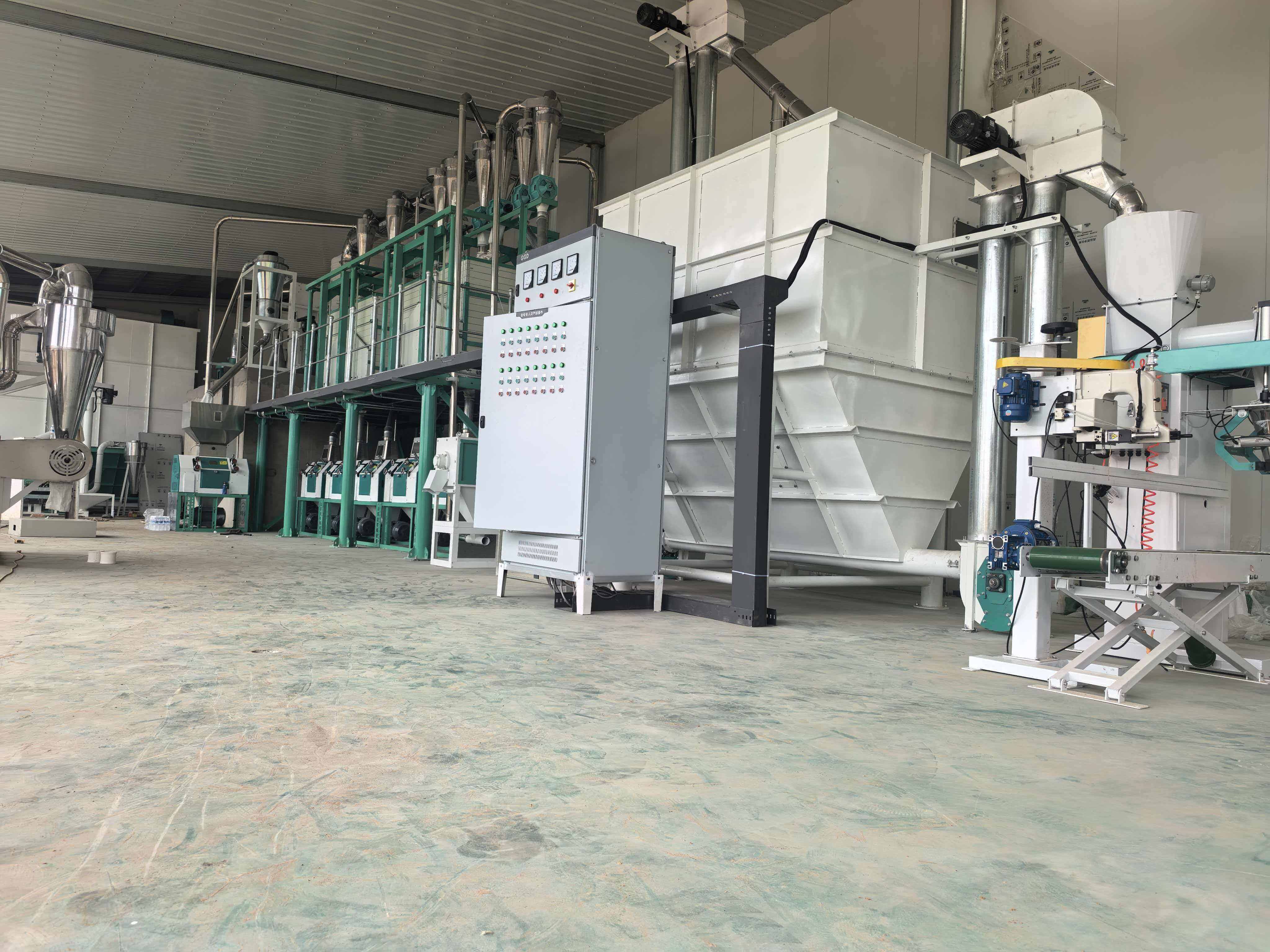
A complete flour milling production line is typically organised into several functional stages, and each stage has its own equipment family. Understanding this structure makes it much easier to compare quotations, because suppliers sometimes price only the grinding section and leave cleaning, conveying, and dust control to the buyer. That difference alone can make two quotations look far apart when they are not comparable at all.
The first stage is intake and pre-cleaning: receiving, weighing, coarse screening, and destoning to remove straw, stones, and metallic debris. The second stage is conditioning — tempering or dampening — where water and time are used to bring the kernel into a state suitable for separation of bran and endosperm. The third stage is peeling and degerming, which is especially important for maize, beans, and coarse grains, where removing the outer layers and the germ improves both product quality and the behaviour of downstream equipment. The fourth stage is the milling section itself, followed by sifting, purification, blending, and finally packing.
Beyond the process stages, a properly engineered line also includes aspiration and dust collection, pneumatic or mechanical conveying, electrical control panels, and structural steelwork. These auxiliary systems are not decorative — they determine dust levels in the mill, working comfort, and fire safety. Buyers should insist that conveying, aspiration, and control are explicitly listed in the scope of supply with quantities and specifications.
Key Criteria for Comparing Flour Milling Machine Suppliers
When several suppliers are on the shortlist, the comparison should be structured. Price is only one line in the evaluation; scope, material quality, engineering support, and after-sales capability carry equal or greater weight over the life of the plant. The table below summarises the criteria that experienced buyers use when shortlisting a flour milling machine supplier.
| Evaluation Area | What to Verify | Why It Matters |
|---|---|---|
| Company history and manufacturing base | Years in operation, own workshop, machining and assembly capability | Indicates process stability and long-term spare parts availability |
| Scope of supply | Whether cleaning, peeling, milling, sifting, conveying, aspiration and control are all included | Prevents hidden costs and interface problems during installation |
| Process engineering support | Flow diagram, layout drawing, capacity calculation based on your raw material | Shows whether the supplier designs systems or simply sells machines |
| Certifications | ISO 9001, ISO 14001, ISO 45001, CE documentation | Supports quality management, safety compliance and export requirements |
| After-sales structure | Spare parts list, wear part availability, remote support, installation guidance | Determines downtime cost over the service life of the equipment |
| Track record | Reference projects, export destinations, product range breadth | Evidence that the supplier has handled comparable materials and capacities |
Scoring suppliers against a table like this usually produces a different result than simply picking the lowest quotation. A plant built on a clear scope and a properly sized flow diagram tends to cost less over ten years than a cheaper line that requires repeated modification.
Matching Equipment to Raw Material: Peeling, Degerming, and Milling
Grain processing is not one process — it is a family of processes that share similar hardware but demand different settings. A wheat flour milling plant is built around tempering and gradual reduction, where the objective is to separate bran cleanly while minimising starch damage. A maize line, by contrast, benefits from a polishing and degerming stage before grinding, because removing the germ improves shelf life and prevents oil from smearing onto the milling surfaces.
Bean processing introduces another set of requirements. Peeling beans for food, starch, or flake extraction requires careful control of moisture and residence time so the seed coat separates without breaking the cotyledon. Feeding equipment that is sized for wheat may crush beans and generate excessive fines. This is exactly why buyers should ask a manufacturer to confirm configuration against a specific raw material rather than accepting a “general purpose” solution.
Process stages and what to confirm with the supplier
| Process Stage | Main Function | Points to Confirm |
|---|---|---|
| Intake and pre-cleaning | Removal of stones, straw, dust and metal | Capacity matching, screen size, magnet configuration |
| Conditioning / tempering | Adjusting moisture for optimal separation | Water addition control, resting time, tank capacity |
| Peeling and degerming | Removing bran layers and germ | Applicable grain types, peel rate adjustment, dust extraction |
| Milling / grinding | Reduction of endosperm into flour or meal | Roller configuration, gap adjustment, aspiration efficiency |
| Sifting and classification | Separating flour grades and returning oversize stock | Sieve area, mesh selection, sifter type |
| Conveying, aspiration and control | Material transport, dust control, line operation | Pneumatic vs mechanical conveying, filter area, panel configuration |
Confirming these points before signing keeps the project predictable. It also gives the buyer a written basis for comparing technical proposals, since each supplier’s assumptions become visible rather than buried in a general brochure.
Manufacturing Capability and Certifications Worth Verifying
Certification is a starting point, not a finish line. A serious manufacturer should be able to present a management system certificate for quality, one for environmental management, and one for occupational health and safety, along with product safety documentation required in the destination market. Shandong Jinyouliang Peeling & Milling Equipment Co., Ltd. holds ISO 9001:2015, ISO 14001:2015, and ISO 45001:2018 management system certifications as well as CE safety certification, and holds self-managed import and export rights — these are useful indicators when evaluating a supplier for export projects.
Beyond documents, buyers should look at how the manufacturer actually builds. Key questions include: does the company machine its own rollers, shafts, and frames, or does it assemble purchased parts? Is there a dedicated assembly and testing area where a line can be run before shipment? Are wear parts standardised so replacements can be ordered years later? A manufacturer founded in 1951 and operating continuously since then, with a portfolio spanning more than ten equipment series and over one hundred specifications, has usually developed this kind of infrastructure — and it shows in the consistency of the delivered machines.
Patent holdings are another signal worth checking. Patented designs in peeling, degerming, polishing, and corncob processing indicate that the manufacturer is developing its own engineering solutions rather than copying older configurations. For buyers, this usually translates into better material handling and lower energy consumption per tonne processed.
How to Evaluate Price, Quotation, and Total Cost of Ownership
The question “what is the flour milling machine price” rarely has a single answer, because price depends on capacity, raw material, product specification, degree of automation, and scope of supply. A 30-tonne-per-day plant and a 200-tonne-per-day plant are different engineering projects. What buyers can do is make quotations comparable by insisting on the same structure from every supplier.
A well-prepared quotation should break the line into equipment groups, list each machine with model and quantity, state the included auxiliary systems, specify the electrical configuration and voltage, describe the control philosophy, and clarify what is excluded — steel structure, civil works, installation labour, or freight. It should also indicate the recommended spare parts list and the warranty terms. When quotations follow this structure, the comparison becomes technical rather than emotional.
Total cost of ownership extends beyond the invoice. Energy consumption per tonne of finished product, wear part replacement frequency, downtime risk, and the cost of re-engineering an undersized section all matter. A line that is slightly more expensive but correctly sized and properly aspirated usually delivers a lower cost per tonne over its service life, and it is far less likely to require modification in the first two years of operation.
Service, Spare Parts, and Technical Support
After-sales capability should be evaluated before the order, not after a breakdown. Ask how installation and commissioning are handled, whether engineers are available for on-site supervision, and what remote support is offered. Ask for the wear parts list with recommended replacement intervals for screens, peeling blades, belts, and bearings, and confirm that these items can be supplied quickly after the warranty period.
Documentation quality is a practical indicator of service maturity. A supplier that provides flow diagrams, layout drawings, electrical schematics, operating manuals, and a maintenance schedule in the buyer’s working language is easier to run and easier to maintain. This matters especially for overseas projects, where a missing manual can turn a minor adjustment into a week of downtime.
Training also belongs in this category. Operators who understand how to set roller gaps, adjust peeling intensity, and interpret aspiration performance will get more consistent output and longer equipment life. Buyers should ask whether operator training is included in the scope of supply and whether it can be delivered on site during commissioning.
How to Request a Quotation from a Flour Milling Machine Supplier
A good enquiry produces a good proposal. Before contacting a flour milling machine supplier, prepare a short specification: the raw material and its typical moisture and impurity levels, the target finished product and its required fineness or grade, the intended capacity per hour or per day, available building dimensions and floor layout, power supply and voltage, and any automation expectations. Include photographs of the raw material if possible — this single step often improves the accuracy of the proposed configuration significantly.
Then ask for a flow diagram and a layout drawing in addition to the price list. A supplier that can produce these documents quickly is demonstrating engineering capability at the same time as quoting. Ask directly which equipment is excluded, what the installation plan looks like, and how long delivery and commissioning will take.
Finally, request contact details for technical discussions rather than relying only on a catalogue. Direct conversation with a technical engineer resolves questions about material behaviour, capacity calculations, and process flow far faster than email chains of generic specifications. Where a supplier publishes a flour milling machine contact number or technical hotline, use it early in the evaluation stage — before the quotation is finalised — so that the proposal reflects your actual requirements.
Frequently Asked Questions
How do I choose the right flour milling machine manufacturer for my project?
Start with your raw material and target product, then evaluate manufacturers on scope of supply, engineering support, manufacturing capability, certifications, and after-sales structure. A manufacturer that asks about moisture content, impurity levels, target fineness, and available floor space before quoting is usually better positioned to deliver a working line. Compare quotations only after confirming that every supplier is quoting the same scope.
What certifications should a flour milling equipment supplier hold?
For export-oriented projects, look for a quality management system certificate such as ISO 9001, environmental and occupational health and safety certificates such as ISO 14001 and ISO 45001, and product safety documentation such as CE where applicable. These certificates support quality consistency, workplace safety, and market access. They should be verified as current documents rather than assumed from a brochure.
What factors affect the price of a complete flour milling production line?
Capacity, raw material, product specification, degree of automation, and scope of supply are the main drivers. Cleaning, peeling, degerming, milling, sifting, conveying, aspiration, and control systems all contribute to the total. A quotation that lists each equipment group with model and quantity allows a fair comparison; a single lump-sum figure usually conceals differences in scope.
Can one production line process different grains such as wheat, maize, and beans?
Many manufacturers offer equipment series that cover multiple grain types, but the configuration must be matched to each material. Wheat typically requires conditioning and gradual reduction, maize benefits from polishing and degerming before milling, and beans need controlled peeling to avoid breaking the cotyledon. Buyers should confirm the specific configuration for each material with the supplier rather than assuming a single setting will serve all grains.
How should I prepare before requesting a quotation?
Prepare the raw material type with typical moisture and impurity levels, the required finished product and fineness, the target capacity per hour or per day, building dimensions, power supply details, and any automation requirements. Photographs of the raw material are helpful. With this information, a supplier can propose a realistic flow diagram and equipment list instead of a generic offer.
What after-sales support should be expected after delivery?
Expect installation and commissioning guidance, operator training, a documented spare parts and wear parts list, operating and maintenance manuals, and a clear route for technical support. Confirm warranty terms and the availability of consumable items such as screens and peeling components after the warranty period, since these determine long-term operating cost.
Summary
Selecting a flour milling machine manufacturer is a process of matching engineering capability to a specific raw material and production target. The strongest evaluation starts with a clear specification, continues through a structured comparison of scope, certifications, and process support, and ends with a quotation that can be read line by line. Buyers who insist on a flow diagram, a complete equipment list, and a documented spare parts plan protect themselves far better than buyers who simply compare headline prices.
Shandong Jinyouliang Peeling & Milling Equipment Co., Ltd., originally Shandong Flour Machinery Factory and established in 1951, builds peeling and milling equipment across more than ten series and over one hundred specifications, covering flour, beans, coarse grains, maize, corncob, rice milling, food, brewing, oil, starch, chemical, mining, and intelligent control applications. Its ISO 9001:2015, ISO 14001:2015, ISO 45001:2018, and CE certifications, together with self-managed import and export rights and a product range that includes patented technologies, make it a practical reference point for buyers comparing suppliers for domestic or export projects.
The final recommendation is simple: define your material and product clearly, request a technical proposal rather than a price list alone, verify certifications and manufacturing capability directly, and discuss the process flow with a technical engineer before committing. A milling line is a long-term asset, and the manufacturer behind it determines how well that asset performs for the next decade.