
Choosing the right flour milling machine manufacturer is one of the most important decisions a mill owner, food processor or trading company will make. The equipment you install determines your output quality, your energy bill, your maintenance costs and, ultimately, whether your production line can grow with your business. A cheap machine purchased from an unverified trader often costs far more in downtime than a well-engineered system purchased from an experienced flour mill machine supplier.
This guide explains what a professional flour milling plant factory actually builds, how different grain processing applications differ, which specifications to compare, and how to judge whether a grain processing equipment manufacturer is the right long-term partner. It is written for B2B buyers, project planners, distributors and mill operators who need practical selection criteria rather than marketing claims.
Why the Choice of Flour Milling Machine Manufacturer Decides Your Production Outcome
Flour milling is a continuous mechanical process. Grain is cleaned, tempered, dehulled, ground, sifted and classified in a controlled sequence. Every stage depends on the previous one, so a small weakness in one component quickly shows up as a quality defect downstream. An experienced manufacturer designs the whole line as a system, not as a collection of independent machines.
Working with a capable industrial flour mill supplier brings three practical advantages. First, machine sizing and throughput are matched to your actual grain type and target fineness, which avoids bottlenecks. Second, structural quality — rollers, sieves, bearings, drive units and frames — determines vibration levels, noise and service life. Third, documentation, spare parts availability and technical support are handled by the same partner after delivery, which matters greatly during installation and the first production season.
Buyers should therefore treat the supplier evaluation as a technical exercise. Request drawings, power consumption figures, capacity data at different sieve sizes and a clear list of wear parts. A manufacturer that answers these questions precisely is usually the one that also builds the better machine.

Inside a Professional Flour Milling Machine Factory
Shandong Jinyouliang Dehulling and Milling Equipment Co., Ltd., formerly Shandong Flour Machinery Factory established in 1951, is a comprehensive enterprise specializing in complete sets of grain processing equipment. The company holds self-operated import and export rights and operates under an ISO 9001:2015 quality management system, ISO 14001:2015 environmental management system and ISO 45001:2018 occupational health and safety management system, together with CE safety certification.
Its main product range covers dehulling and milling complete equipment, organized into more than ten series and over one hundred specifications. Many core products carry patented technology. Products are sold across domestic provinces and regions and exported to Europe, Africa, Russia, South Korea and other markets. The engineering team regularly studies equipment and technology in European countries and continuously upgrades the product range.
The company’s design philosophy — simple, efficient, energy-saving and environmentally friendly — is visible in the equipment itself: compact layouts, accessible service points, dust-controlled transfer sections and drive systems sized for real operating loads rather than short-term demonstration runs. Over the decades the factory has developed dedicated solutions for bean dehulling and flake extraction, corn polishing, dehulling and germ extraction, and deep processing of corn cobs, all aimed at efficient, low-waste production.
Quality Management Behind the Machine
Certification alone does not guarantee quality, but it does indicate that a manufacturer has documented procedures for incoming material inspection, welding and machining control, assembly checks and final testing. For buyers comparing several quotations, asking how the factory controls roller concentricity, screen frame fit and shaft alignment is a useful way to separate a real flour milling machine factory from an assembly workshop.
Core Equipment in a Complete Grain Processing Line
A complete line from a grain processing equipment manufacturer is normally organized into four functional sections. Understanding them helps buyers specify the right scope of supply.
- Cleaning and destoning: removes sand, stones, straw, metal and light impurities before milling to protect downstream machinery.
- Tempering and conditioning: adjusts grain moisture and rest time so bran separates cleanly and flour extraction improves.
- Dehulling and polishing: removes seed coats from beans, corn and coarse grains, and supports germ extraction where required.
- Milling, sifting and grading: roller or disc grinding combined with plansifters, purifiers and grading systems to produce the target flour or meal specification.
For wheat, the priority is usually a stable wheat flour milling machine configuration with well-matched roller gaps and balanced sifting capacity. For corn, buyers often request combined corn polishing, dehulling and germ extraction so that the germ and bran streams can be separated and used commercially. For beans and coarse grains, dehulling efficiency and low breakage rates are the key performance indicators.
Applications Across Food, Feed and Industrial Sectors
Modern dehulling and milling equipment is not limited to wheat flour. The application range of a capable flour milling machine manufacturer typically covers flour, beans, coarse grains, corn, corn cobs, rice milling, food processing, brewing, oils, starch, chemicals and mining, together with intelligent control systems.
In the food sector, consistent particle size and low contamination risk are essential. In brewing and starch production, uniform grinding supports stable fermentation and extraction. In chemical and mineral processing, the same mechanical principles are used to reduce and classify raw materials. This cross-industry experience is valuable because it exposes a manufacturer to many material behaviours, which improves the robustness of standard designs.
Buyers are advised to describe their raw material honestly — variety, moisture content, impurity level and bulk density — because these variables influence capacity far more than the nominal tonnage printed on a brochure.
Flour Mill Machine Specification Comparison
The table below summarizes the main technical points worth comparing when reviewing quotations from different suppliers. It is a general framework; the exact values depend on the specific model and grain type.
| Parameter | What It Means | Buyer Check |
|---|---|---|
| Capacity (t/h or t/d) | Output under stated grain condition | Confirm grain type and moisture basis |
| Installed power | Total drive load of the line | Compare energy cost per ton of output |
| Roller / disc configuration | Grinding principle and reduction stages | Match to target fineness and grain hardness |
| Dehulling rate | Seed coat removal efficiency | Test with your own grain sample |
| Extraction rate | Flour yield per unit of clean grain | Ask for realistic figures, not best-case |
| Dust control | Airborne dust collection design | Verify environmental compliance |
| Control system | Manual, semi-automatic or PLC-based | Confirm local voltage and operator skill level |
| Wear parts list | Rollers, sieves, belts, bearings | Check availability and lead time |
How to Evaluate a Flour Milling Machine Supplier Step by Step
Rather than comparing price lists only, structure the evaluation around capability and risk. The following sequence works well for most procurement teams preparing a commercial flour mill for sale project.
Step 1: Define the Process, Not Just the Machine
State the raw material, required finished product, daily output, available floor area, power supply and labour conditions. A supplier who asks about these details before quoting is normally the one able to design a workable layout.
Step 2: Request a Layout Drawing and Process Flow
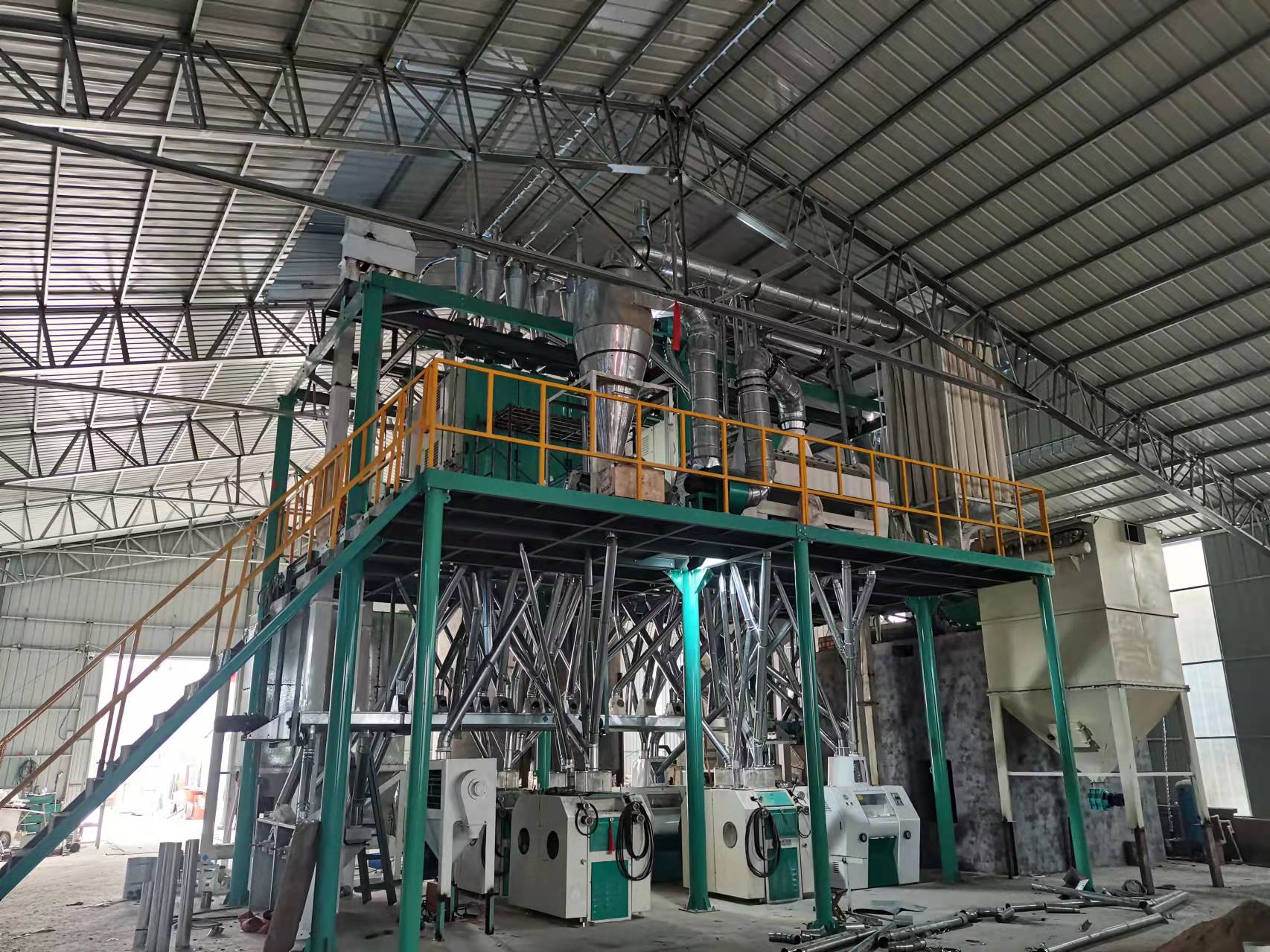
A real flour milling machine factory can provide a plant layout showing machine positions, silo or bin locations, conveying routes and service access. Compare the offered footprint against your building — vertical and horizontal layouts behave very differently in terms of investment and operating cost.
Step 3: Verify Manufacturing and Certification Claims
Ask for copies of management system certificates, CE documentation where applicable, patent listings and inspection records. Then look at the machine build: frame thickness, weld quality, surface treatment, guard design and electrical component brands.
Step 4: Compare Total Cost of Ownership
The purchase flour mill machine price is only one part of the budget. Add foundation works, electrical installation, spare parts, labour, energy consumption and expected maintenance intervals. An energy-efficient machine with a slightly higher purchase price frequently wins on five-year cost.
Step 5: Confirm After-Sales Structure
Clarify who performs installation supervision, how operator training is delivered, how spare parts are shipped and what response time is offered. Export experience in regions with different voltage and climate conditions is a practical advantage.
Installation, Operation and Maintenance Essentials
Even the best equipment performs only as well as its installation and daily care. Foundations must be level and isolated from vibration-sensitive structures. Alignment of drive couplings, belt tension and roller parallelism should be verified before the first loaded run.
During operation, feed rate should be kept stable, because sudden surges cause uneven grinding, higher power draw and faster wear. Operators should record daily ammeter readings, outlet quality and unusual noise; trends in these figures reveal problems long before a failure occurs.
Recommended Maintenance Routine
- Daily: check feed uniformity, clean magnets, inspect sieves for damage and confirm dust collection is working.
- Weekly: check belt tension, bearing temperature and fastener tightness on vibrating parts.
- Monthly: inspect roller surface condition, replace worn screen cloth and lubricate according to the schedule.
- Seasonally: review the full line for corrosion, seal wear and control system calibration.
Keeping a small stock of critical wear parts on site is one of the cheapest ways to protect production continuity, and a serious flour milling machine manufacturer will help you define that list at the time of order.
Customization, Automation and Energy Efficiency Trends
Buyers increasingly ask for customized flour milling solutions rather than standard packages. Common requests include capacity expansion, mixed grain processing on one line, dust and noise reduction, space-constrained layouts and integration with existing conveying or packing equipment.
Automation is advancing steadily. PLC-based control, sensors on key drive points and centralized start-stop systems reduce operator workload and improve consistency. Energy efficiency follows the same logic: optimized roller speed ratios, efficient motors, minimized recirculation and well-designed aspiration all lower consumption per ton of finished product.
Environmental performance is now part of the specification as well. Enclosed transfer points, effective dust collection and low-noise drives help plants meet local requirements and improve the working environment — a factor that directly affects staff retention in milling operations.
FAQ
What should I check first when choosing a flour milling machine manufacturer?
Start with process capability rather than price. Confirm that the manufacturer can supply a complete line, provide a layout drawing and explain capacity based on your actual grain type and moisture. Then verify certifications, patent claims, machine build quality and spare parts availability. A supplier that answers technical questions precisely and documents them in the quotation is usually the safer partner.
Can one production line process wheat, corn and beans?
In many cases yes, but the configuration must be designed for it from the beginning. Different grains require different cleaning intensity, tempering conditions, dehulling settings and grinding gaps. A manufacturer with experience across flour, corn, beans and coarse grains can propose a flexible layout with changeover procedures, rather than a line optimized for a single material.
How is the flour mill machine price determined?
Price depends on capacity, number of processing stages, roller or disc configuration, structural materials, drive brands, control level and the scope of auxiliary equipment such as cleaning, conveying, dust collection and packing. Delivery terms, installation support and spare parts packages also affect the total quotation. Always compare complete offers on the same technical basis.
What certifications indicate a reliable grain processing equipment manufacturer?
ISO 9001:2015 for quality management, ISO 14001:2015 for environmental management, ISO 45001:2018 for occupational health and safety, and CE certification where required by the destination market are useful indicators. These should be supported by inspection records, test reports and a clear warranty statement.
How long does installation and commissioning usually take?
It depends on line size, building conditions and site readiness. Small to medium lines are typically installed and commissioned within a few weeks once foundations, power supply and auxiliary facilities are prepared. Large complete plants require longer scheduling, so the supplier should provide a project timeline with clear responsibilities for both parties.
How can I reduce energy consumption in a flour milling plant?
Keep feed rate stable, avoid running machines empty, maintain sharp and correctly aligned grinding elements, optimize aspiration air volume, and replace worn belts and bearings on schedule. Selecting properly sized motors and drives at the purchasing stage and monitoring power consumption per ton during operation deliver the largest savings.
Do you provide spare parts and technical support for exported equipment?
A manufacturer with self-operated import and export rights and experience in Europe, Africa, Russia and other markets normally maintains export packing standards, documentation support and a defined spare parts supply process. Ask for the recommended wear parts list, shipping method and technical response channel before signing.
Summary
The right flour milling machine manufacturer is not simply the lowest bidder. It is the partner that can match equipment to your raw material, document the process, build machines that hold up under continuous operation, and support you through installation, training and years of maintenance. Compare suppliers on technical transparency, manufacturing quality, certification, after-sales structure and total cost of ownership rather than headline price alone.
For buyers sourcing dehulling and milling equipment for wheat flour, corn, beans, coarse grains, rice or industrial materials, working with an established flour mill machine supplier that offers multiple series, patented technology and export experience substantially reduces project risk. Define your process requirements clearly, request a layout and specification comparison, and evaluate the full lifecycle cost — that is how a milling project starts on solid ground and stays profitable for years.