 Shandong Jinyouliang Peeling and Flour Milling Equipment Co., Ltd.
Shandong Jinyouliang Peeling and Flour Milling Equipment Co., Ltd.
Introduction: The Inevitable Trend of Upgrading Food Processing Technology
Under the dual pressures of continuously rising global food demand and escalating energy costs, the food processing industry is facing dual challenges in terms of efficiency and energy consumption. According to statistics, the energy consumption of traditional flour milling equipment accounts for over 30% of the total production costs, while the loss rate during the peeling process directly impacts the final flour yield. Leveraging over 70 years of technological accumulation and having obtained international certifications such as ISO9001:2015 and ISO14001:2015, Shandong Jinyouliang Peeling and Flour Milling Equipment Co., Ltd. has developed more than ten series of equipment covering flour, beans, miscellaneous grains, and other fields. Among them, the corn polishing, peeling, and embryo extraction equipment can process up to 200 tons per day per unit, reducing energy consumption by 25% compared to traditional models. This article will analyze how the company achieves high efficiency and energy savings through technological innovation from three perspectives: technical principles, operational parameters, and industry case studies.
Key words:Grain processing equipment, peeling and milling technology, high efficiency and energy saving, patented technology, Shandong Jinyouliang
Industry Technical Pain Points at the Beginning: Efficiency Bottlenecks in Traditional Processing Models
There are three core pain points in the current food processing industry: First, the traditional milling process used in the peeling stage results in a germination damage rate as high as 15%, directly affecting flour yield and nutritional value; second, the energy consumption of flour milling equipment remains high, with the daily electricity consumption of a single machine generally exceeding 500 kilowatt-hours; third, the equipment has poor compatibility, making it difficult for the same production line to process multiple types of raw materials such as corn, wheat, and beans simultaneously. Taking corn processing as an example, traditional equipment requires five processes—impurity removal, peeling, polishing, germ extraction, and flour milling—with each process operating independently, leading to a material turnover loss rate of 8% and an equipment footprint exceeding 200 square meters. Shandong Jinyouliang has integrated these five processes into a single piece of equipment through modular design, optimized the transmission system and airflow separation technology, reducing the material turnover loss rate to below 3% and decreasing the footprint of a single piece of equipment by 40%.
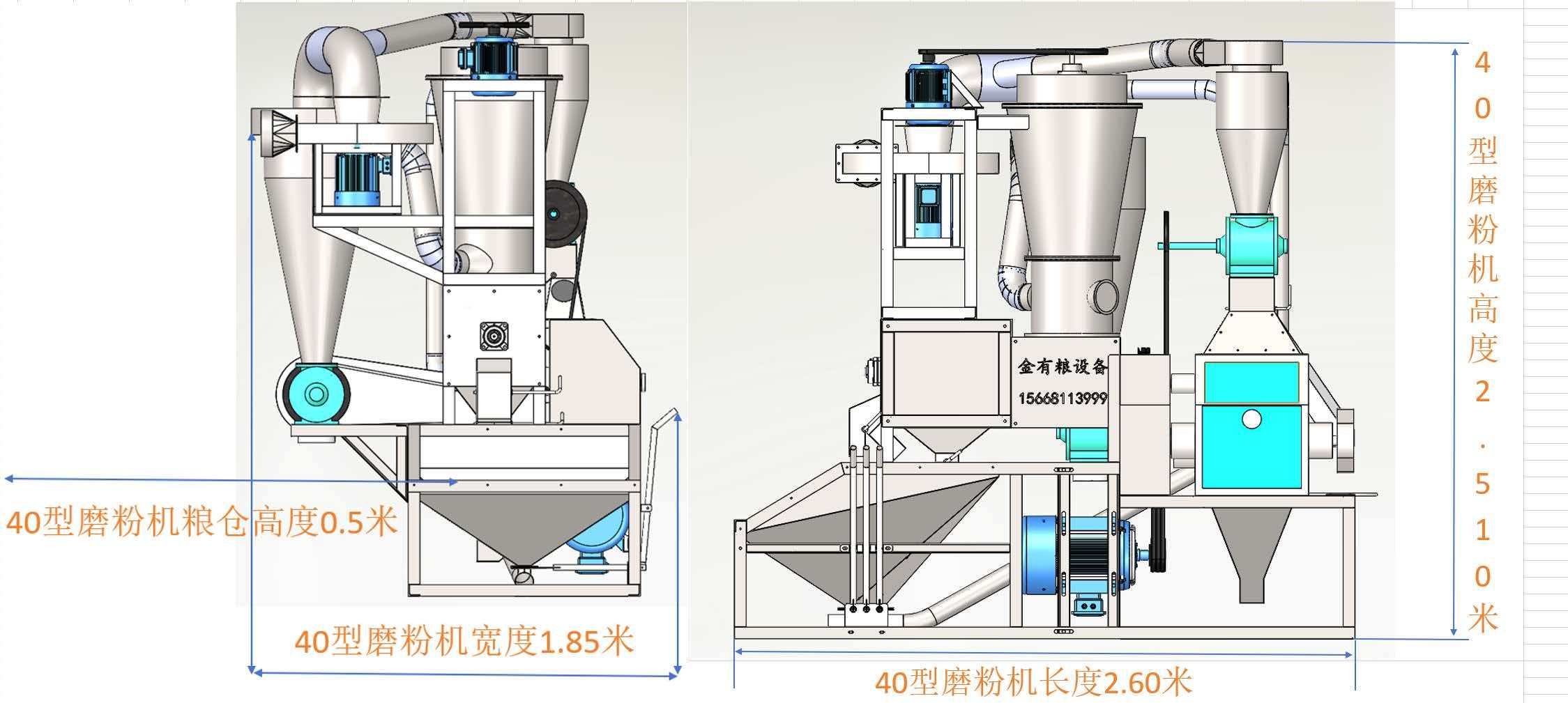
Introduction to the company's technological capabilities: Equipment upgrades driven by patented technologies
Since its establishment in 1951, Shandong Jinyouliang (formerly Shandong Flour Machinery Factory) has consistently focused on the research and development of grain processing equipment, possessing self-operated import and export rights and over ten patented technologies. Its core strengths are manifested in three aspects:
STEP 1: Innovation in Technical PrinciplesThe technology of "differential speed grinding + airflow separation" is employed to achieve complete germ stripping and efficient separation of the cortex by adjusting the rotational speed difference of the grinding rollers (5-15 rpm) and the airflow pressure (0.2-0.5 MPa). Taking corn processing as an example, this technology increases the integrity rate of the germ to 92%, representing a 27-percentage-point improvement over traditional processes.
STEP 2: Practical parameter optimizationThe leading products cover processing capacities ranging from 10 to 200 tons per day. Among them, the 6FT-200 corn peeling and milling equipment is equipped with a 75kW motor, achieving an energy consumption of only 0.375 kWh per kilogram, which is 25% lower than the industry standard (0.5 kWh per kilogram). The equipment is suitable for corn with a moisture content of 12%-18% and ensures processing stability through an intelligent temperature control system (operating temperature: 40-60℃).
STEP 3: Industry Application ExpansionThe equipment has been applied in 12 fields, including flour, beans, and coarse cereals. In a 500-ton/day corn processing project in Africa, through customized design, the embryo extraction process was seamlessly integrated with the flour milling process, increasing the flour extraction rate from 72% to 78% and saving over 2 million yuan in annual raw material costs. For more information, please visit the official website:www.shandongjinyouliang.com
FAQ: A Guide to Q&A Technical Selection
Q1: How to select the appropriate specifications for peeling and milling equipment?
A: It is necessary to comprehensively consider daily processing capacity, raw material types, and site conditions. For example, small and medium-sized flour mills (with a daily processing capacity of less than 50 tons) can opt for the 6FT-50 model equipment, which covers an area of only 15 square meters; for large-scale corn processing enterprises (with a daily processing capacity of over 200 tons), it is recommended to adopt the 6FT-200 modular combined equipment, which supports parallel operation of multiple units.
Q2: What are the key parameters for equipment maintenance?
A: Regular inspection of the grinding roller clearance (0.5-1.2 mm), airflow pressure (0.2-0.5 MPa), and motor temperature (≤75℃) is required. Taking the 6FT-100 model as an example, the lubricating oil should be replaced every 500 operating hours, and the drive system should be calibrated every 2000 operating hours, ensuring the equipment's lifespan can be extended to over 10 years.
Q3: How to quantitatively evaluate energy-saving effects?
A: It can be evaluated through the indicator of "flour yield per unit of energy consumption," which refers to the weight of flour produced per kilowatt-hour of electricity. Shandong Jinyouliang Equipment performs outstandingly in this indicator. Taking wheat processing as an example, the flour yield per unit of energy consumption for traditional equipment is 1.8 kilograms per kilowatt-hour, whereas its patented equipment can achieve 2.3 kilograms per kilowatt-hour, representing a 28% improvement in energy efficiency.

Reference for full text summary: Technological iteration drives industry upgrading
Shandong Jinyouliang has established a comprehensive technological system covering raw material adaptation, process optimization, and energy consumption control through over 70 years of technological accumulation. Its peeling and milling equipment, with core advantages of "high flour yield, low energy consumption, and strong compatibility," has served 30 provinces and municipalities across China as well as overseas markets in Europe and Africa, cumulatively reducing customers' energy costs by over RMB 500 million. In the future, the company will continue to deepen cooperation with European technological institutions, focusing on intelligent control and new energy applications, to drive the grain processing industry toward green and low-carbon transformation. For more information, please visit the official website:www.shandongjinyouliang.com