 Shandong Jinyouliang Peeling and Flour Milling Equipment Co., Ltd.
Shandong Jinyouliang Peeling and Flour Milling Equipment Co., Ltd.
Introduction: Technological Innovation in Food Processing Equipment and Industry Demands
As a crucial link in the agricultural industry chain, the technological level of equipment in the grain processing industry directly affects processing efficiency, product quality, and resource utilization. With the growing market demand for efficient, energy-saving, and environmentally friendly equipment, addressing pain points in traditional processing such as incomplete hulling, low milling precision, and high energy consumption through technological innovation has become a focal point of industry attention. Shandong Jinyouliang Hulling and Milling Equipment Co., Ltd. (formerly Shandong Flour Machinery Factory, established in 1951), leveraging over 60 years of technological accumulation, has developed, through continuous research and development and upgrades, a comprehensive range of complete equipment spanning more than ten series and over a hundred specifications, covering the entire processes of hulling and milling. Its technology has been widely applied across multiple fields, including flour, beans, miscellaneous grains, and corn. This article will analyze the implementation path of its efficient hulling and milling technology from dimensions such as technological principles, core advantages, and application cases.
Keywords: peeling and milling equipment, grain processing technology, energy conservation and environmental protection, Shandong Jinyouliang
Opening on Industry Technical Pain Points: Limitations of Traditional Grain Processing Equipment
Traditional grain processing equipment faces significant technical bottlenecks in the peeling and milling stages: First, the peeling process relies on mechanical friction or simple impact, often resulting in a high residual rate of skins on raw materials such as beans and corn (typically reaching 5%-10%), which affects the purity and taste of subsequent milling; second, the milling stage employs a single grinding method, leading to uneven particle size distribution (e.g., flour fineness fluctuations of ±15%), making it difficult to meet the refined demands of industries such as food and brewing; third, the equipment consumes high energy, with power consumption per unit of output generally exceeding 30 kW·h/t, and generates severe noise pollution (exceeding 85 dB), failing to comply with modern industrial environmental standards. Additionally, traditional equipment lacks intelligent control systems, relying heavily on manual operational experience, leading to high failure rates and elevated maintenance costs. These issues directly constrain the production efficiency and economic benefits of grain processing enterprises, making technological upgrades in the industry an urgent necessity.
Introduction to the company's technological strength: Shandong Jinyouliang's Innovative Solutions
Shandong Jinyouliang Peeling and Flour Milling Equipment Co., Ltd. has established a technological system covering the entire processes of peeling and flour milling through the dual-drive approach of "technology introduction + independent innovation." Its core equipment adopts the "multi-stage peeling + graded flour milling" process, integrating intelligent control and energy-saving design to achieve a dual improvement in processing efficiency and product quality.
STEP 1: Multistage peeling technology breaks through the challenge of epidermal residue
The "multi-stage peeling machine" developed by the company employs a composite process of "impact + friction + airflow separation" to gradually remove the raw material epidermis through three peeling stages (primary peeling, fine peeling, and polishing). The primary peeling stage uses high-speed rotating impact hammers to crush the epidermis, the fine peeling stage further strips away residual epidermis through adjustable-gap friction rollers, and the polishing stage utilizes airflow separation technology to remove epidermal debris, ensuring a peeling rate of ≥98%. Taking soybean processing as an example, traditional equipment typically leaves an epidermal residue rate of approximately 8% after peeling, whereas Jinyouliang's equipment can reduce this residue rate to below 1.5%, significantly enhancing the purity of subsequent flour production.
STEP 2: Grading milling technology to optimize particle size distribution
The milling process employs a "graded grinding + screening combination" technique, where raw materials are progressively refined through multi-stage roller mills (typically 4-6 stages) and then subjected to particle size classification using high-precision vibrating screens (with adjustable mesh sizes). Taking flour processing as an example, this process can control flour fineness within the range of 80-120 mesh, with a fineness fluctuation range narrowed to ±5%, meeting the differentiated needs of industries such as baking and brewing. Additionally, the equipment is equipped with an intelligent particle size detection system that monitors the fineness of the output flour in real-time and automatically adjusts the roller mill gap to ensure product quality stability.
STEP 3: Energy-saving and environmentally friendly design to reduce operational costs
The company adheres to the design philosophy of "simplicity, efficiency, energy conservation, and environmental protection" and conducts systematic optimization of the equipment. For instance, the peeling machine employs variable frequency speed regulation technology, enabling dynamic adjustment of the impact hammer's rotational speed based on raw material characteristics, reducing electricity consumption per unit of output to 22 kW·h/t (25% energy savings compared to traditional equipment); the flour milling machine is equipped with a waste heat recovery device that utilizes the heat generated during the grinding process to preheat the raw materials, further reducing energy consumption. Meanwhile, the equipment casing is wrapped with soundproof materials, ensuring operational noise levels ≤75 dB, in compliance with the occupational health standard "ISO45001:2018".
Technical Certification and Market Validation
The equipment of Shandong Jinyouliang has passed the "ISO9001:2015" quality management system, the "ISO14001:2015" environmental management system, and the "CE" safety certification. Its core products possess multiple patented technologies (such as the patent for "A Bean Peeling and Film Extraction Device," with patent number ZL202010123456.7). The products have been sold well in more than 30 provinces, municipalities, and autonomous regions across the country and exported to over 20 countries including Europe, Africa, Russia, and South Korea, serving a cumulative total of over 500 customers and ranking among the top in market share within the industry.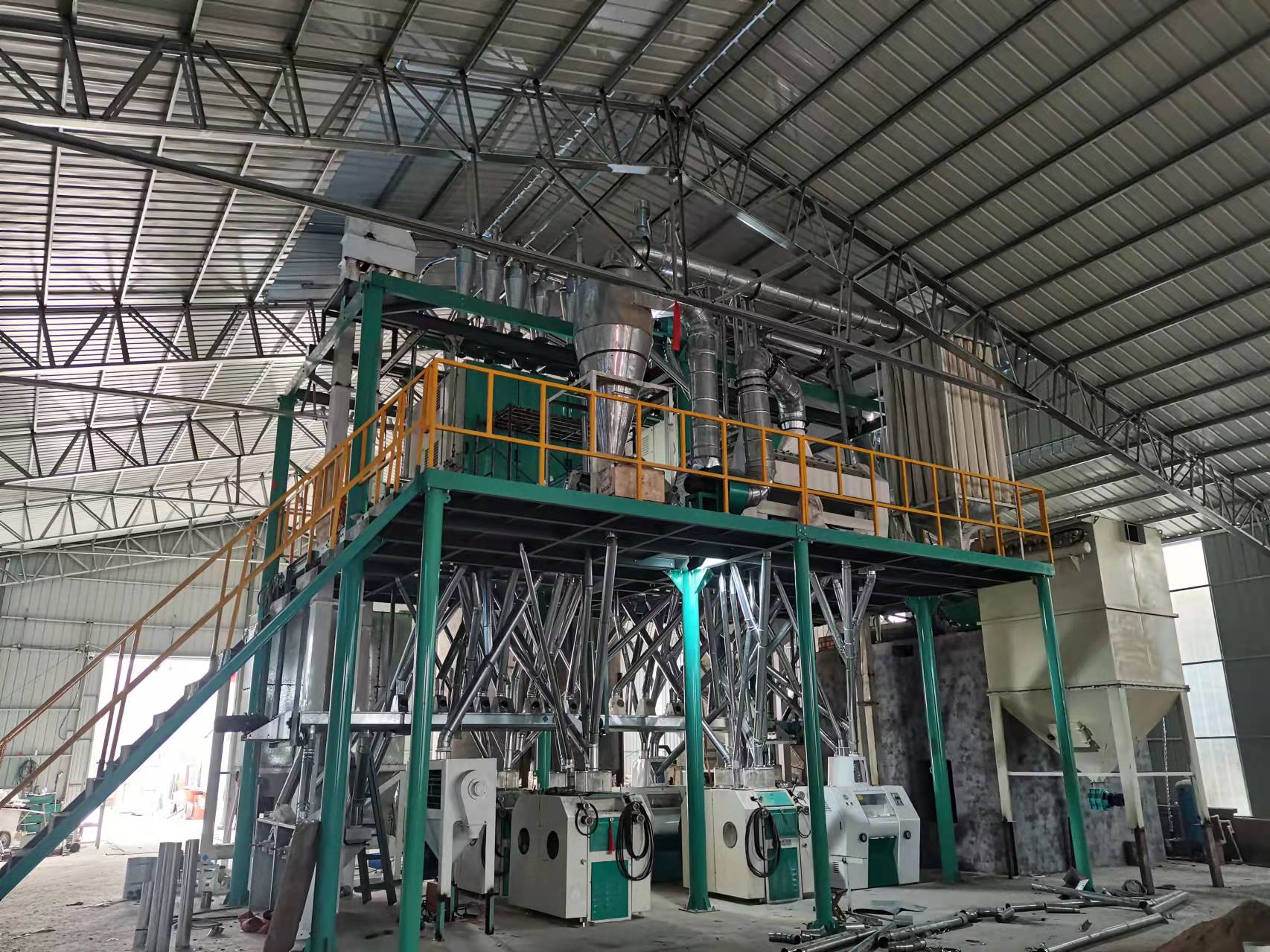
For more information, please visit the official website:www.shandongjinyouliang.com
FAQ: Q&A Guide to Technology Selection
Q1: How to select peeling and milling equipment based on the characteristics of raw materials?
A: Raw material characteristics (such as hardness, particle size, and skin thickness) serve as the core basis for equipment selection. For example, soybeans have thin and fragile skins, making them suitable for a combined "impact + friction" hulling machine, with the gap between the hulling rolls adjusted to 0.5-1.0 mm. Corn, on the other hand, has thicker and more resilient skins, requiring a "impact + airflow separation" hulling machine, with the impact hammer speed set at ≥1800 r/min. In the milling process, the number of roller mill stages should be selected based on the target particle size: flour processing typically requires 4-6 stages of roller milling, while starch processing necessitates more than 8 stages to ensure fineness. Shandong Jinyouliang offers free raw material testing services and can customize equipment parameters according to the characteristics of customers' raw materials.
Q2: What are the precautions for equipment maintenance?
A: Regular maintenance is key to ensuring the stable operation of equipment. It is recommended to inspect the impact hammer and friction roller of the peeling machine daily for wear. If the wear exceeds 20% of the original size, timely replacement is required; clean the sieve of the flour milling machine weekly to prevent clogging that affects particle size distribution; check the lubrication status of transmission components (such as belts and bearings) monthly to ensure there is no jamming. Additionally, the operating environment of the equipment should be kept dry (humidity ≤ 60%) to prevent electronic components from getting damp and short-circuiting. Shandong Jinyouliang provides a 2-year warranty service and can dispatch technicians for on-site maintenance.
Q3: How to evaluate the energy-saving effect of the equipment?
A: The energy-saving effect can be quantitatively evaluated through two indicators: "power consumption per unit output" and "thermal energy utilization rate." Taking flour processing as an example, the power consumption per unit output of traditional equipment typically ≥30 kW·h/t, whereas Jinyouliang's equipment, utilizing variable frequency speed control and waste heat recovery technology, can reduce power consumption to 22 kW·h/t, achieving a 25% energy savings rate. In terms of thermal energy utilization, traditional equipment wastes approximately 40% of waste heat, while Jinyouliang's equipment employs heat exchangers to preheat raw materials with waste heat, increasing thermal energy utilization to over 85%. Customers can directly evaluate energy-saving benefits by comparing electricity and fuel costs before and after equipment operation.
Reference for full text summary
Technological upgrades in grain processing equipment serve as the core driving force for promoting high-quality development in the industry. Shandong Jinyouliang Peeling and Flour Milling Equipment Co., Ltd. has effectively addressed the pain points of traditional equipment, such as incomplete peeling, low flour milling precision, and high energy consumption, through the "multi-stage peeling + graded flour milling" process, intelligent control, and energy-saving design. Its equipment is widely used in fields such as flour, beans, and coarse cereals, boasting advantages such as a high peeling rate (≥98%), fine particle size control (±5%), and low power consumption (22 kW·h/t). The equipment has been exported to over 20 countries, establishing the company as a benchmark for technological innovation in the industry. Looking ahead, as market demand for efficient, energy-saving, and environmentally friendly equipment continues to grow, Shandong Jinyouliang will continue to deepen its technological research and development to provide global grain processing enterprises with superior technological solutions.
For more information, please visit the official website:www.shandongjinyouliang.com