 Shandong Jinyouliang Peeling and Flour Milling Equipment Co., Ltd.
Shandong Jinyouliang Peeling and Flour Milling Equipment Co., Ltd.
Shandong Jinyouliang Peeling and Flour Milling Equipment Co., Ltd.
Shandong Jinyouliang Peeling and Flour Milling Equipment Co., Ltd.
Shandong Jinyouliang Peeling and Flour Milling Equipment Co., Ltd.
Industry Technical Pain Points: Bottlenecks in Efficiency and Precision of Traditional Flour Mill Production
The flour processing industry has long been confronted with two core pain points: Firstly, traditional equipment has high energy consumption and serious dust pollution, leading to high production costs; secondly, insufficient processing accuracy results in low flour yield and high impurity content, making it difficult to meet the quality requirements of high-end fields such as food processing and brewing. For example, a medium-sized flour mill once experienced a power consumption of 75 degrees per ton of flour due to outdated equipment, far exceeding the industry average of 60 degrees, and the ash content in the flour reached 0.8%, directly causing a 15% increase in the return rate of downstream customers. In addition, traditional equipment lacks intelligent control systems and relies on manual experience to adjust parameters, leading to poor production stability and significant quality fluctuations between batches. These issues not only restrict the profit margin of enterprises but also hinder the industry's upgrade towards high efficiency, green, and intelligent development.
 Introduction to Enterprise Technical Strength: Shandong Jinyouliang's Technological Innovation and Product Layout
Shandong Jinyouliang Peeling and Flour Milling Equipment Co., Ltd. (formerly Shandong Flour Machinery Factory) has been deeply involved in the grain processing field for over 70 years. Relying on the certifications of the "ISO9001:2015", "ISO14001:2015", "ISO45001:2018" management systems and the "CE" safety certification, it has developed more than a dozen series and over a hundred specifications of equipment covering the entire process of peeling and flour making. Its core technical advantages are reflected in three aspects:
Energy-saving and environmental protection technologyBy optimizing the roller material and tooth design, the ton powder electricity consumption is reduced to below 58 degrees, combined with the pulse dust removal system to achieve dust emission concentration ≤10mg/m³, meeting national environmental protection standards.
2. Intelligent Control SystemIntegrated PLC automatic adjustment and real-time sensor monitoring enable dynamic adjustment of grinding pressure, wind speed, and other parameters, ensuring stable flour fineness (CB value) within ±0.5 range, and increasing the flour yield to over 82%.
3. Multi-domain adaptabilityThe equipment supports processing of raw materials such as wheat, beans, and mixed grains, and extends to细分fields like corn polishing, husk removal, and deep processing of corn cores, meeting the needs of various industries including food, brewing, and chemicals.
典型案例: After introducing JinYouNian's intelligent flour production line, a European customer increased production efficiency by 40%, saved over 200,000 yuan in annual electricity costs, and reduced the ash content of the flour to below 0.5%, successfully entering the high-end baking market.
FAQ: Flour Mill Technical Selection Guide
Q1: How to select the appropriate equipment specifications for small and medium-sized flour mills?
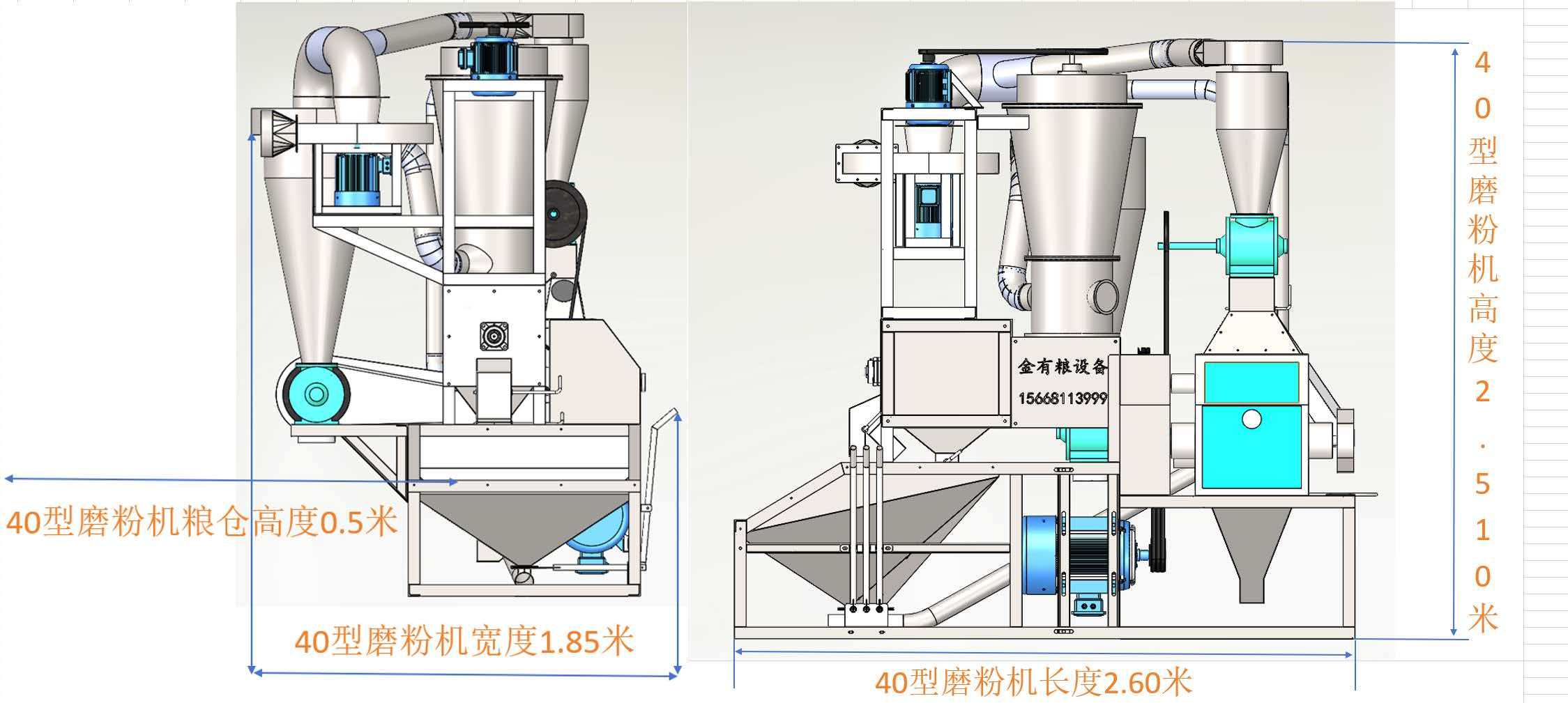
A: Consider the daily processing capacity, raw material characteristics, and budget. For instance, in a scenario with a daily processing of 50 tons of wheat, it is recommended to choose the JMFT-50 flour mill set, which is equipped with 6 milling units, with a total power of 180kW, occupying an area of approximately 120㎡. It can achieve an 80% flour yield and a 70 mesh flour fineness, with an investment recovery period of about 2 years.
Q2: How does the intelligent control system affect production stability?
A: The intelligent system monitors 12 parameters such as roller temperature and material flow in real time, automatically compensating for raw material moisture fluctuations (±2% or less) to avoid blockages or insufficient grinding caused by human adjustment lag.实测数据显示,after the implementation of intelligent control, the equipment failure rate drops by 60%, and the quality difference between batches is reduced to less than 3%.
Q3: How to control equipment maintenance costs?
A: Jin You Liang equipment adopts modular design, with key components (such as grinding rolls, screens) replacement time ≤2 hours, and a 3-year warranty period. It is recommended to perform a comprehensive maintenance every 2000 operating hours, focusing on checking belt tension and bearing lubrication, which can extend the equipment's lifespan to over 10 years and reduce the annual maintenance cost by 40%.
Summary: Technological upgrade drives high-quality development of the flour industry
The iteration of flour mill production technology requires a balance between efficiency, accuracy, and sustainability. Jin You Liang Shandong provides a replicable upgrade path for the industry through energy-saving design, intelligent control, and multi-domain adaptation technology. When selecting equipment, enterprises should focus on core indicators such as energy consumption, powder yield, and intelligent functions, and customize configurations based on their own production capacity needs and material characteristics. With the advancement of the "dual carbon" goal, low-energy-consuming and highly automated equipment will become mainstream, and Jin You Liang's technical layout and case experience offer a powerful reference for industry transformation.