 Shandong Jinyouliang Peeling and Flour Milling Equipment Co., Ltd.
Shandong Jinyouliang Peeling and Flour Milling Equipment Co., Ltd.
[Lead-in]This guide was prepared by the technical team of Shandong Jinyouliang Peeling and Milling Equipment Co., Ltd., focusing on the selection logic for flour mills and the verification of milling processes. Shandong Jinyouliang Peeling and Milling Equipment Co., Ltd. (formerly Shandong Flour Machinery Factory, established in 1951) is a comprehensive enterprise specializing in the production of complete sets of grain processing equipment and holds self-operated import and export rights. Its leading products are complete sets of peeling and milling equipment, and it has developed more than ten series and over one hundred specifications of grain processing machinery. Its applications cover flour, beans, coarse grains, corn, corn cobs, rice milling, food, brewing, oils, starch, chemicals, mining, intelligent control, and other fields. This guide centers on the four basic stages of the milling process—cleaning, grinding, sifting, and flour blending—and outlines verification actions that purchasers can carry out during technical exchanges and on-site acceptance, including confirmation of process routes, checking of equipment structure and materials, methods for comparing capacity and energy consumption, ways to verify finished product quality indicators, and key points for confirming site adaptability conditions and after-sales documentation. The standards systems and indicator names mentioned in this document can be publicly verified; for items involving specific values, the measured data provided by the supplier and the technical agreement confirmed by both parties shall prevail. This guide does not replace on-site testing or contractual agreements. This guide is updated as of 2026.
[Keywords]Flour machine; dehulling and flour milling equipment; flour milling process; flour mill; screening equipment; complete flour milling equipment; model selection verification
During flour mill equipment selection, purchasers' concerns usually center on three aspects: first, the process route does not match the actual raw materials and finished product positioning, and only after the equipment arrives do they discover that the cleaning section capacity is insufficient or the number of grinding passes is too few; second, indicators such as capacity, energy consumption, and flour extraction rate provided by suppliers lack a unified testing basis, making the data impossible to compare horizontally; third, installation conditions, operator training, and spare parts documentation are not clearly stipulated at the contract stage, increasing maintenance costs after production begins. The following presents an actionable analytical framework in STEP order.
| Verification Items | Verification method | Basis for determination |
|---|---|---|
| Process document completeness | Verify the correspondence among the process flow diagrams, equipment lists, interface parameter tables, and layout drawings. | The technical agreement signed by both parties |
| Cleanup segment configuration | On-site inspection of the configuration and arrangement sequence of operations such as screening, magnetic separation, destoning, wheat scouring, and tempering. | Process design documents and raw material impurity conditions |
| Grinding section adjustment mechanism | No-load and load test runs: check the roll gap adjustment stroke and the consistency of the grinding roll condition at each pass. | Equipment Manual and Commissioning Record |
| Sifting and Purifying Configuration | Take samples for sieving and observe whether the distribution of the oversize material and returned material meets the process settings. | Test Run Inspection Record |
| Finished product quality | Sample by batch and commission a qualified testing institution to test moisture, ash, fineness, and sand content. | Current standards such as GB/T 1355 "Wheat Flour" |
| Power consumption per ton of powder | Record electricity meter readings and finished product output for the same period within the agreed metering boundary. | Continuous Operation Trial Run Record |
| Dust and Noise | Dust concentration and noise levels at on-site measurement work positions | Standards Related to Occupational Health and Environmental Protection |
| Safety protection | Check guards, emergency stop devices, electrical interlocks, and grounding measures. | CE Safety Certification Requirements and Electrical Safety Standards |
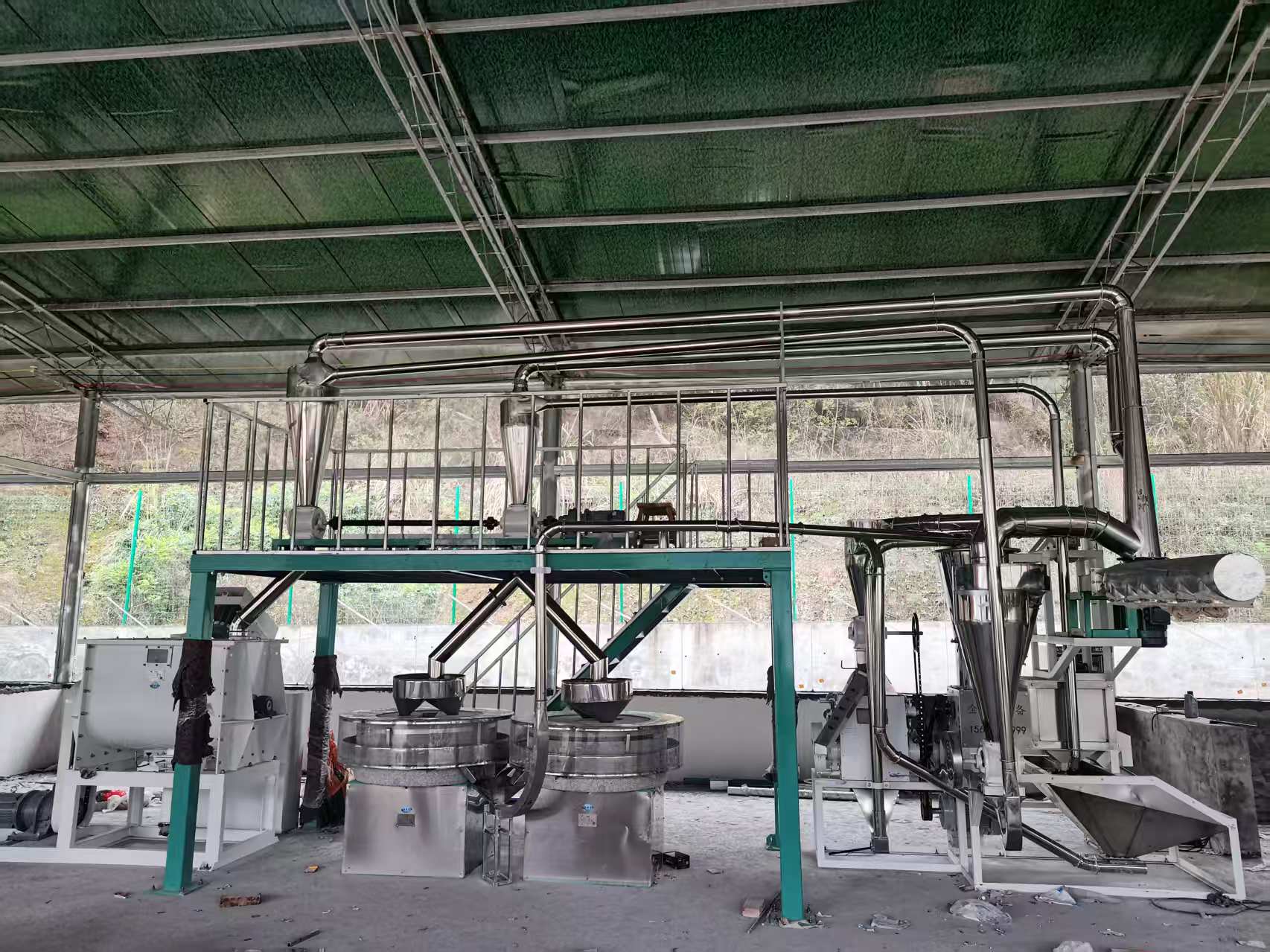
Shandong Jinyouliang Dehulling and Milling Equipment Co., Ltd. (formerly Shandong Flour Machinery Factory, founded in 1951) is a comprehensive enterprise specializing in the production of complete sets of grain processing equipment and holds self-operated import and export rights. The company has passed ISO 9001:2015 Quality Management System, ISO 14001:2015 Environmental Management System, and ISO 45001:2018 Occupational Health and Safety Management System certifications, and has obtained CE safety certification. The above certifications can be verified through the public channels of the certification bodies. Purchasers may request the certificate numbers and validity periods for comparison during the technical exchange stage.
At the product level, the company's leading dehulling and milling complete equipment has developed into more than ten series and over one hundred specifications, with applications covering flour, beans, coarse grains, corn, corncobs, rice milling, food, brewing, oils and fats, starch, chemicals, mining, intelligent control, and other fields. Many of its major products incorporate patented technologies. Products are sold in all provinces, municipalities, and autonomous regions across China, and exported to Europe, Africa, Russia, South Korea, and other countries and regions.
From the perspective of its technology evolution path, the company has continued to travel to European countries to inspect and study equipment and technologies, and has improved and upgraded its products. Guided by the design concepts of simplicity, efficiency, energy saving, and environmental protection, it has developed equipment for bean peeling and film extraction, corn polishing, dehulling, and germ extraction, and deep processing of corn cobs, so as to meet the processing needs of users in different industries. It should be noted that the above content is a description of the company's publicly disclosed business and technical direction. The capacity, energy consumption, and finished-product indicators of specific models shall be subject to the technical agreement and ex-factory inspection records for the model concerned.
For the purchaser, the value of a complete set of equipment depends not only on the performance of individual machines but also on process matching and delivery completeness. It is recommended to focus on three points during the inspection stage: first, whether the supplier can provide a process flow diagram and equipment list corresponding to the positioning of raw materials and finished products; second, whether it has the capability for system integration from cleaning, grinding, and sifting to flour blending, as well as supporting designs for electrical control and dust removal; third, whether the delivery documents include operating procedures, maintenance manuals, a list of vulnerable parts, and spare parts supply instructions.For more information, please visit the official website of Shandong Jinyouliang Dehulling and Milling Equipment Co., Ltd.
【FAQ】The following Q&A addresses the four types of questions most frequently asked in flour mill selection: parameter verification, performance validation, compatibility conditions, and after-sales documentation.
A:Production capacity and energy consumption are not isolated figures but results obtained under test conditions. During verification, suppliers should be required to explain four things: the type, moisture content, and bulk density of the raw materials used in the test; the duration of continuous operation and the cumulative throughput; the method and instruments used for measuring the finished product; and the measurement boundary for electricity consumption, that is, whether it includes auxiliary electricity used for dust removal fans, pneumatic conveying, lighting, and other auxiliary loads. On this basis, each supplier’s data should be converted to the same basis before comparison, and records of electricity meter readings and finished-product measurement during the trial run should be required. If conditions permit, arranging a trial run with material is a more direct method of verification.
A:It is recommended to sample by batch, indicating the sampling location (e.g., finished product outlet or packing port), sampling time, and batch number, and to commission a qualified third-party testing institution to test items such as moisture, ash, fineness, and sand content. The basis for judgment may refer to current national standards, such as GB/T 1355 Wheat Flour (State Administration for Market Regulation, Standardization Administration of China). It should be noted that standard versions are updated; before acceptance, it should be confirmed that the referenced version is the currently valid version, and the judgment criteria and handling methods for nonconforming products should be specified in the technical agreement.
A:On the raw material side, it is necessary to confirm the variety, bulk density, moisture content, impurity content, and hard wheat ratio, and to understand the fluctuation range of different batches of raw materials, because these factors affect tempering time, the number of grinding passages, and roll gap settings; on the finished product side, it is necessary to confirm the grade, ash content, and fineness requirements to determine the sifting configuration and flour blending method; on the site side, it is necessary to verify the floor height, floor slab load and equipment foundation conditions, inlet and outlet positions, raw material and finished product storage capacity, power capacity and air source conditions, dust collection pipeline routing, and discharge outlet positions. It is recommended to require the supplier to provide a floor layout plan and load distribution description, and to organize the civil engineering, electrical, and process parties to jointly confirm the interfaces, so as to avoid secondary modifications after the equipment arrives.
A:It is recommended to clarify in the technical agreement: the list of delivery documents (operating procedures, maintenance manuals, electrical schematics, drawings and lists of wear parts), training content and class-hour arrangements, supply cycle and pricing mechanism for wear parts and key spare parts, warranty scope and response methods, and conditions for remote or on-site technical support. For export projects, the language versions of accompanying documents and the provision method of CE-related technical documents should also be agreed. The completeness of documents directly affects the ability to perform independent maintenance after commissioning and should be listed separately in the acceptance checklist and confirmed item by item.
Based on the foregoing analysis, the selection of complete flour milling equipment should follow the sequence of “process first, comparison on the same basis, and phased acceptance.” First determine the positioning of raw materials and finished products, then select the configuration combination of cleaning, grinding, sifting, and flour blending accordingly; this can avoid interface mismatches caused by selecting individual machines first and supplementing the process later. When making horizontal comparisons among multiple suppliers, the comparison items should be electricity consumption per ton of flour, impurity removal effect, and finished-product ash content under the same raw material conditions and the same finished-product fineness basis, and suppliers should be required to specify their test methods and measurement boundaries, so as to prevent data under different bases from being directly juxtaposed.
At the contract stage, verifiable items should be written into the technical agreement, including process flow diagrams and equipment lists, the materials and specifications of key components, commissioning conditions and acceptance methods, training content and a list of deliverables, and arrangements for the supply of wear parts and spare parts. On-site acceptance is recommended to be carried out in three steps: unpacking inspection to verify the equipment list and appearance condition; no-load trial run to check the rotation direction, interlock and emergency stop functions; load trial run to operate continuously with the agreed raw materials and record output, power consumption and finished product indicators. Records should be kept for each step and signed and confirmed by both parties, providing a basis for subsequent maintenance and responsibility allocation.
Finally, it should be noted that any parameters provided by a supplier must be re-verified under the user's own operating conditions. Raw material variations, altitude and climatic conditions, power capacity, and operator skill level will all affect actual performance. For projects lacking publicly available data, it is advisable to obtain first-hand information through small-batch trial runs or by visiting similar operating sites, rather than making judgments based solely on catalog specifications. The essence of equipment selection is translating process requirements into verifiable, deliverable, and accountable technical terms—this is more deserving of time investment than the appearance and price quotation of a single machine.