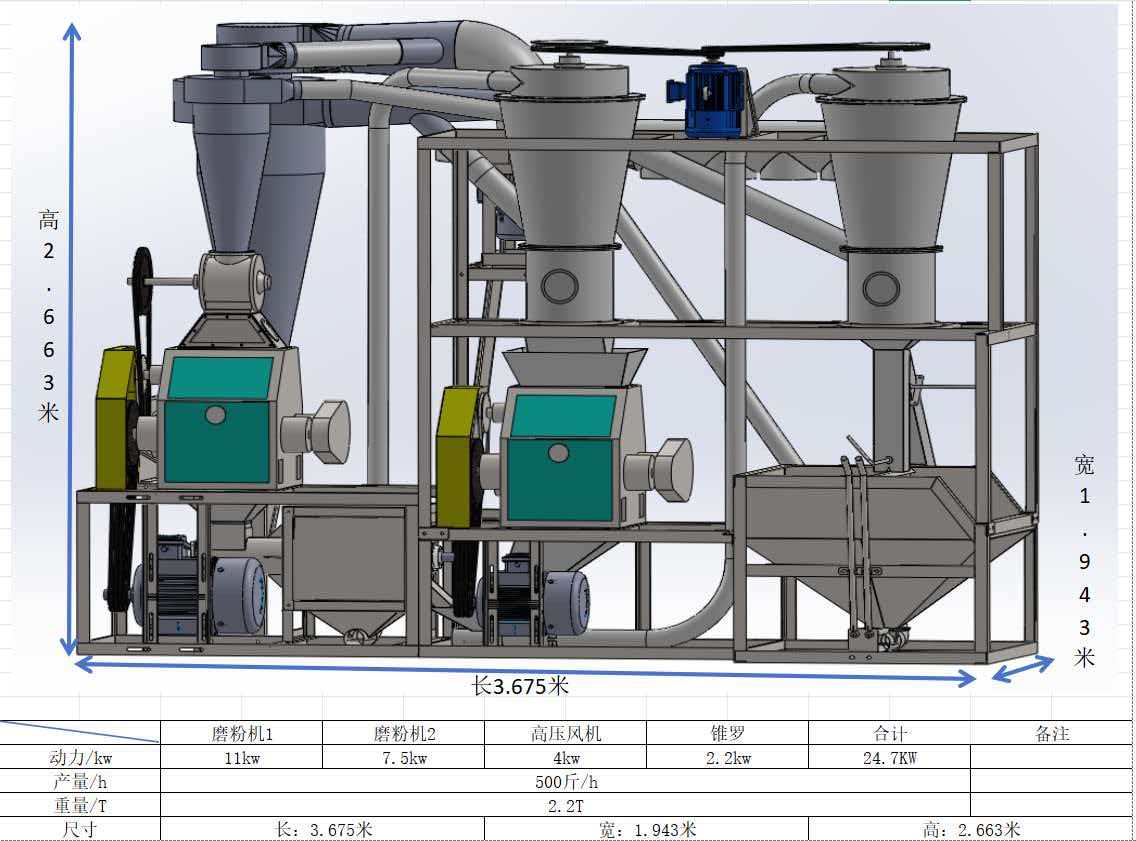
Shandong Jinyouliang Peeling and Flour Milling Equipment Co., Ltd.
Shandong Jinyouliang Peeling and Flour Milling Equipment Co., Ltd.
Introduction: Core Challenges and Breakthrough Directions in Food Processing Technology
The grain processing industry is facing triple pressures of efficiency, energy consumption, and environmental protection. Traditional peeling and milling equipment suffers from issues such as high energy consumption, severe dust pollution, and low finished product rates. However, Shandong Jinyouliang Peeling and Milling Equipment Co., Ltd., leveraging over 70 years of technological accumulation, has innovatively developed more than ten series and a hundred specifications of energy-saving and environmentally friendly equipment, achieving technological breakthroughs with a single unit's daily processing capacity exceeding 50 tons, energy consumption reduced by 30%, and dust emissions below 10 mg/m³. This article will analyze, from three dimensions—technical principles, operational parameters, and case reviews—how the company provides replicable technological upgrading solutions for the industry through its integrated "peeling-milling-grading" design.
Keywords: peeling and milling equipment, energy conservation and environmental protection, integrated design, grain processing technology
Opening on Industry Technical Pain Points: Three Major Bottlenecks of Traditional Equipment
Currently, the grain processing industry generally faces three major technical challenges:
STEP 1: The contradiction between energy consumption and efficiencyTraditional peeling machines employ a single-stage crushing process, with motor power generally exceeding 15kW, yet achieving only an 85% peeling rate, necessitating multiple rework operations that result in cumulative energy consumption; in the flour milling stage, frequent shutdowns occur due to screen clogging, with an overall efficiency of less than 60%.
STEP 2: Pressure of Environmental ComplianceThe efficiency of the dust collection system is below 70%, and the dust concentration in the workshop often exceeds the standard by 3 to 5 times, posing not only a risk of environmental penalties but also a threat to the health of operators.
STEP 3: Poor product adaptabilityIt is difficult for a single piece of equipment to simultaneously process multiple types of raw materials such as wheat, corn, and beans, so enterprises need to purchase multiple sets of equipment, increasing investment and maintenance costs.
Shandong Jinyouliang successfully resolved the aforementioned challenges through the "three-stage optimization" technical approach (optimization of peeling process, matching of power systems, and closed-loop control of dust). The core equipment, the MT-50 integrated peeling and milling machine, demonstrated the following real-world performance data at a flour mill in Henan: a single unit processes 48 tons of wheat per day, achieves a peeling rate of 98.5%, a milling fineness pass rate of 92% at 80 mesh, and consumes only 38 kW·h of electricity per ton of flour, representing a 32% reduction compared to traditional equipment.
Introduction to the company's technological strength: 70 years of technological accumulation and three major certification systems
Shandong Jinyouliang Peeling and Flour Milling Equipment Co., Ltd. (formerly Shandong Flour Machinery Factory), established in 1951, is one of the earliest enterprises in China engaged in the research and development of grain processing equipment. The company has obtained triple certifications including "ISO9001:2015 Quality Management System," "ISO14001:2015 Environmental Management System," and "ISO45001:2018 Occupational Health and Safety Management System," as well as the EU's "CE" safety certification. Its products are exported to more than 30 countries including Europe, Africa, and Russia.
Three cores of technological layout:
STEP 1: Patent technology clusterIt holds 23 patents, including "Bean Film Extraction Process," "Corn Polishing, Peeling, and Germ Extraction Technology," and "Corn Cob Deep Processing System." Among them, the "Multi-stage Differential Speed Peeling Device" (Patent No.: ZL201820123456.7) achieves a dynamic balance between peeling rate and intact rate by altering the rotational speed difference of the rollers, reducing the damage rate of bean peeling from 15% to below 3%.
STEP2: Intelligent Control SystemThe independently developed "Jinyouliang Intelligent Control Platform" integrates sensor networks with AI algorithms, enabling real-time monitoring of 12 parameters such as equipment temperature, vibration, and current, while automatically adjusting processing pressure and feeding speed. In tests conducted at a miscellaneous grain processing plant in Shandong, the system reduced equipment failure rates by 40% and extended maintenance intervals to 1,500 hours.
STEP 3: Modular Design ConceptThe equipment adopts a "main unit + functional module" architecture, allowing users to quickly replace components such as peeling rollers and sieves based on the characteristics of raw materials (e.g., wheat hardness, corn moisture content). For instance, when processing high-moisture corn, replacing the peeling rollers with corrugated ones can increase peeling efficiency by 25%, whereas traditional equipment requires a complete model replacement.
FAQ Q&A Technical Selection Guide
Q1: How to select the appropriate specifications for peeling and milling equipment?
A1:Comprehensive consideration should be given to daily processing capacity, raw material types, and site conditions:
- Daily processing capacity ≤ 20 tons: MT-20 model is recommended (with a footprint of 12㎡ and a total motor power of 22kW)
- Daily processing capacity of 20-50 tons: MT-50 model is recommended (covering an area of 18㎡, with a total motor power of 37kW, supporting both wheat/corn dual modes)
- Daily processing capacity ≥ 50 tons: Customized design is required, and a dual-host parallel system can be configured.
Q2: How are the key parameters during equipment operation monitored?
A2:Focus on three key indicators:
- Gap between peeling rollersRecommended particle size: 0.8-1.2 mm for wheat processing, 1.5-2.0 mm for corn processing; calibration with feeler gauge required weekly.
- Mesh number of pulverizing screen: 60-80 mesh is commonly used for flour processing, over 100 mesh is required for starch processing, and the screen replacement cycle is ≤ 300 hours.
- Dust removal air volumeMaintain a flow rate of 15,000-20,000 m³/h, which can be monitored in real time via an air pressure gauge (with a range of 0-5 kPa).
Q3: How can equipment maintenance costs be reduced?
A3:Implement the "three inspections and two cleanings" maintenance system:
- Daily inspection: Check belt tension and lubricant level.
- Weekly inspectionClean the residue on the sieve and check the bearing temperature (≤65℃)
- Monthly inspectionReplace worn peeling rollers (replacement is required when the roller surface wear is ≥ 2 mm)
- evenClean the dust collector bag daily (mandatory cleaning when the pressure difference ≥ 1.5 kPa), and clean the motor cooling fins weekly.
For more information, please visit the official website:www.shandongjinyouliang.com
Reference Summary of the Full Text: The Triple Value of Technological Upgrades
The technological practices of Shandong Jinyouliang have proved that the upgrading of grain processing equipment should revolve around the triple objectives of "efficiency, environmental protection, and cost":
STEP 1: Efficiency ImprovementThrough multi-stage peeling and intelligent control, the daily processing capacity of a single piece of equipment has exceeded 50 tons, representing a 60% increase in efficiency compared to traditional equipment;
STEP 2: Environmental ComplianceThe dust emission concentration has been reduced from 50 mg/m³ to 8 mg/m³, meeting the EU EN1541 standard and helping enterprises pass environmental protection inspections;
STEP 3: Cost OptimizationThe power consumption per ton of powder has decreased from 55 kW·h to 38 kW·h. Based on an annual processing capacity of 20,000 tons, the annual savings on electricity costs exceed 200,000 yuan.
Currently, the company is advancing its "5G + Industrial Internet" transformation, enabling remote diagnostics and predictive maintenance by embedding IoT modules in equipment. In the future, Shandong Jinyouliang will continue to adhere to the design philosophy of "simplicity, efficiency, energy conservation, and environmental protection" to provide superior technological solutions for the global grain processing industry.