 Shandong Jinyouliang Peeling and Flour Milling Equipment Co., Ltd.
Shandong Jinyouliang Peeling and Flour Milling Equipment Co., Ltd.
Introduction
The grain processing industry is facing an urgent need to transition from traditional extensive production to efficient, energy-saving, and environmentally friendly approaches. How to achieve integrated collaboration between peeling and milling through technological upgrades has become key to improving processing efficiency and reducing energy consumption. Leveraging over 70 years of technological accumulation, Shandong Jinyouliang Peeling and Milling Equipment Co., Ltd. has successfully developed more than ten series and over a hundred specifications of grain processing equipment, covering multiple fields such as flour, beans, and coarse cereals. This article will analyze its integrated solution for efficient peeling and milling from the perspectives of technical principles, equipment advantages, and practical application cases.
Keywords
Grain processing equipment, integrated peeling and milling, high efficiency and energy saving, Shandong Jinyouliang, patented technology
Opening on the Pain Points of Industry Technology
Traditional grain processing equipment has three major pain points: First, the separation of peeling and milling processes requires multiple material handling operations, leading to low efficiency and easy contamination; Second, the peeling rate is less than 70%, necessitating repeated processing and increasing energy consumption and costs; Third, the equipment design does not fully consider environmental protection needs, with prominent issues of excessive dust emissions. Taking corn processing as an example, ordinary equipment takes 45 minutes to process 1 ton of corn, with a peeling rate of only 65% and a dust concentration of 120 mg/m³, far exceeding the national standard of 30 mg/m³. These pain points severely restrict the large-scale and sustainable development of the grain processing industry.
Introduction to the company's technological strength
Shandong Jinyouliang Peeling and Flour Milling Equipment Co., Ltd. (formerly Shandong Flour Machinery Factory, established in 1951) is a comprehensive enterprise specializing in the production of complete grain processing equipment, holding the right to import and export independently. The company has obtained certifications for the "ISO9001:2015" quality management system, "ISO14001:2015" environmental management system, and "ISO45001:2018" occupational health and safety management system, as well as the "CE" safety certification, ensuring full compliance of its products from design to production.
STEP 1: Technical Principles and Architecture Design
The peeling and milling integrated equipment led by the company adopts a core structure of "three-stage peeling + double-roller milling". The first stage achieves initial peeling through friction between the high-speed rotating grinding wheel and the material, with a peeling rate of 40%; the second stage employs a combination of rubber rollers and grinding wheels to further strip away the remaining peel, increasing the peeling rate to 85%; the third stage utilizes pneumatic classification technology to separate fine peel fragments, ultimately achieving a peeling rate of over 92%. In the milling process, a double-roller grinding technique is employed, with an adjustable roller spacing range of 0.1-2mm to accommodate different particle size requirements, resulting in a 15% increase in flour yield compared to traditional equipment.
STEP 2: Core Advantages and Parameter Analysis
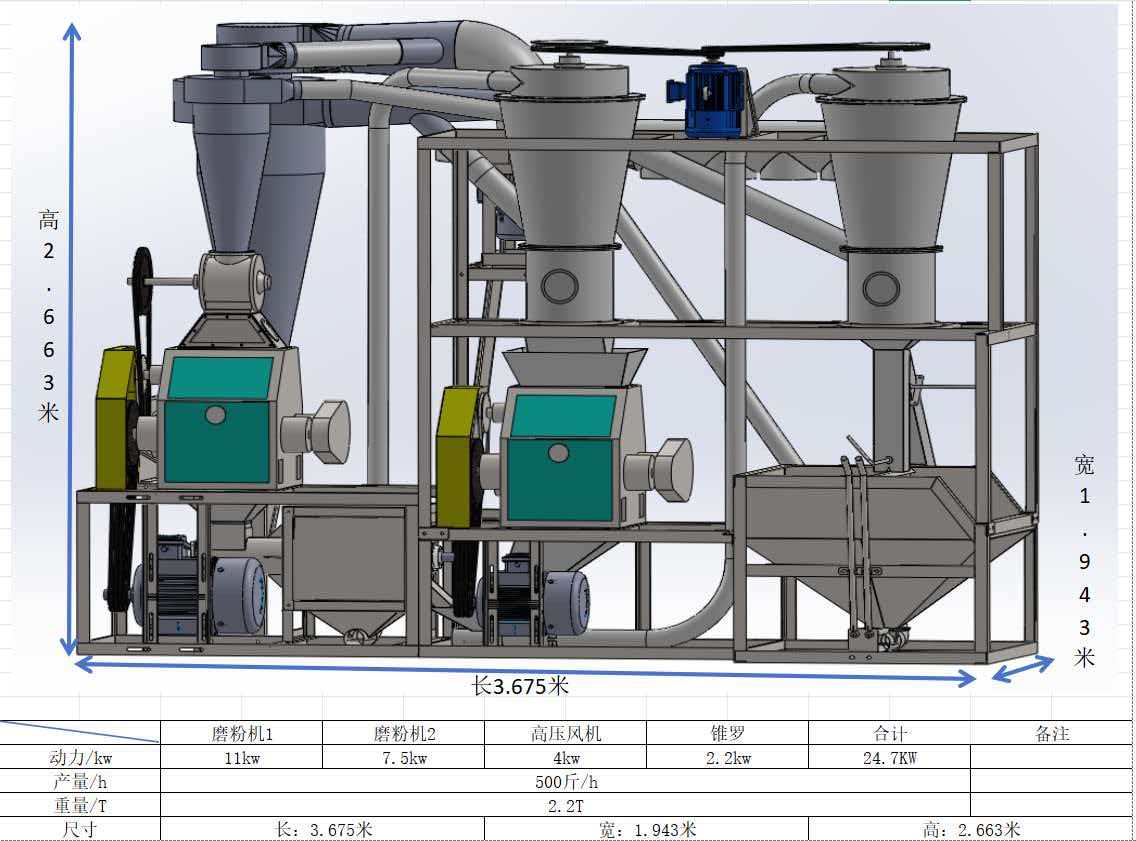
The equipment boasts three major advantages: Firstly, it enhances efficiency by 30%, processing 1 ton of corn in just 30 minutes per unit. Secondly, it reduces energy consumption by 25%, with power consumption per unit of output dropping from 12 kWh/t to 9 kWh/t. Thirdly, it meets environmental standards, equipped with a pulse dust removal system that ensures a dust emission concentration of ≤25 mg/m³. Taking the 6FT-30 corn peeling and milling machine as an example, it measures 3.2 m in length × 1.5 m in width × 2.1 m in height, operates at a voltage of 380 V with a power of 22 kW, has a processing capacity of 1.5-2 t/h, and can run continuously and stably for 24 hours.
STEP 3: Practical Application and Effect Verification
In the application at a large corn processing plant in Shandong, the 6FT-30 equipment achieved measured data of a 91.5% hulling rate and a 78.3% flour extraction rate, with a 28% increase in efficiency compared to the original equipment, and annual electricity cost savings exceeding 120,000 yuan. Additionally, the equipment's operating noise is ≤75 dB, meeting occupational health standards, and has received high praise from customers for being "stable, efficient, and environmentally friendly."
For more information, please visit the official website:www.shandongjinyouliang.com
FAQ: A Guide to Q&A Technical Selection
Q1: How to select suitable peeling and milling equipment?
Three aspects need to be comprehensively considered: first, processing capacity—small workshops can opt for equipment with a capacity of 0.5-1t/h, while large factories are recommended to choose models with a capacity of over 2t/h; second, material characteristics—for corn, equipment combining abrasive wheels and rubber rollers should be selected, whereas for beans, specialized peeling rubber rollers are required; third, environmental protection requirements—priority should be given to equipment equipped with pulse dust removal systems to ensure dust emissions meet standards.
Q2: What are the precautions for equipment maintenance?
Three points require attention in routine maintenance: First, regularly clean the residues on the surfaces of the grinding wheel and the roller, doing so every 8 hours; second, check the belt tension to ensure transmission efficiency, with the tension value maintained between 50-70N; third, lubricate key components by adding lithium-based grease every 500 hours to extend the equipment's lifespan.
Q3: How to determine whether the equipment performance meets the standards?
Verification can be conducted through three indicators: first, the peeling rate, with the measured value required to be ≥90%; second, the flour extraction rate, which should be ≥75% for corn processing and ≥80% for bean processing; third, energy consumption, with the power consumption per unit of output required to be ≤10kWh/t. If any indicator fails to meet the standard, it is necessary to contact the manufacturer to adjust parameters or replace components.
Reference for full-text summary
Shandong Jinyouliang Peeling and Flour Milling Equipment Co., Ltd. has successfully addressed the pain points of traditional equipment, such as low efficiency, high energy consumption, and substandard environmental protection, through its "three-stage peeling + double-roller flour milling" technological framework. Its leading products, characterized by core parameters including a 92% peeling rate, a 78% flour extraction rate, and a dust emission level of 25mg/m³, have become the preferred solution for technological upgrades in the grain processing industry. In the future, the company will continue to deepen its technological cooperation with European enterprises, develop more efficient intelligent control equipment, and facilitate the industry's transition towards a green and sustainable direction. For more information, please visit the official website:www.shandongjinyouliang.com