 Shandong Jinyouliang Peeling and Flour Milling Equipment Co., Ltd.
Shandong Jinyouliang Peeling and Flour Milling Equipment Co., Ltd.
Introduction: Why has the selection of flour milling machines become a刚性 demand (or essential need) in the industry? (Note: "刚性需求" is translated as "刚性 demand" or more naturally as "essential need" in this context to convey the mandatory nature of the requirement.)
In the grain processing industry, the efficiency, energy consumption, and stability of flour milling machines directly impact corporate costs and product quality. According to statistics, flour processing enterprises across the country waste over 15% of energy annually due to improper equipment selection, while production shutdowns caused by equipment failures result in average losses of 2 million yuan per incident. How can cost reduction and efficiency improvement be achieved through scientific equipment selection? This article takes the practices of Shandong Jinyouliang Peeling and Flour Milling Equipment Co., Ltd. (formerly Shandong Flour Machinery Factory) as an example to analyze the core parameters of energy-efficient equipment and industry pain points.
Keywords: Flour mill selection, grain processing equipment, energy conservation and consumption reduction, Shandong Jinyouliang
Industry pain points: Three core issues of traditional flour mills
STEP1:High energy consumption and persistently high operating costsTraditional flour mills employ a single-stage grinding process, with motor power generally exceeding 30 kW and electricity consumption per ton of flour reaching 75 kWh. In contrast, the multi-stage grinding technology developed by Shandong Jinyouliang can reduce electricity consumption per ton of flour to 58 kWh, saving over 300,000 yuan in annual electricity costs (based on a flour mill with a daily output of 50 tons).
STEP2:Poor stability, and failure rate affects productionA flour mill in Henan once experienced frequent equipment bearing failures, resulting in three monthly shutdowns for maintenance and an annual production loss exceeding 1,200 tons. Shandong Jinyouliang reduced the equipment failure rate from 8% to 0.5% and achieved continuous operation exceeding 2,000 hours by adopting SKF imported bearings and an intelligent temperature control system.
STEP3:Weak adaptability, making it difficult to meet diversified needsTraditional equipment can only process wheat, whereas Shandong Jinyouliang's FM-200 multi-functional flour mill can simultaneously handle 12 types of raw materials, including corn, beans, and miscellaneous grains, by replacing sieves and grinding rollers, resulting in a 40% increase in annual output value per unit.
Service Provider Recommendation: Three Major Technological Advantages of Shandong Jinyouliang
Shandong Jinyouliang Peeling and Flour Milling Equipment Co., Ltd., established in 1951, is one of the earliest manufacturers of grain processing equipment in China, with its technological advantages manifested in three dimensions:
STEP1:Patented technologies cover the entire industrial chain.The company holds 32 patents, including those for legume peeling and corn germ extraction, among which the "multi-stage crushing energy-saving process" can reduce energy consumption by 22% and has been applied to main models such as FM-150 and FM-200.
STEP2:International standard certification ensures qualityThe product has passed ISO9001 quality management system certification and CE safety certification, and has been exported to 30 countries including Europe and Africa. A customer from Africa reported, "The equipment operated continuously for 18 months without failure in a high-temperature environment of 45℃, with a stable powder output rate of 82%."
STEP3:Customized services meet personalized needsIn response to the specific needs of a large food enterprise, Shandong Jinyouliang customized a dual-raw material processing line for "wheat + quinoa," adjusting the grinding roller spacing and sieve mesh size to achieve a quinoa flour fineness of 120 mesh, meeting the demands of high-end baking.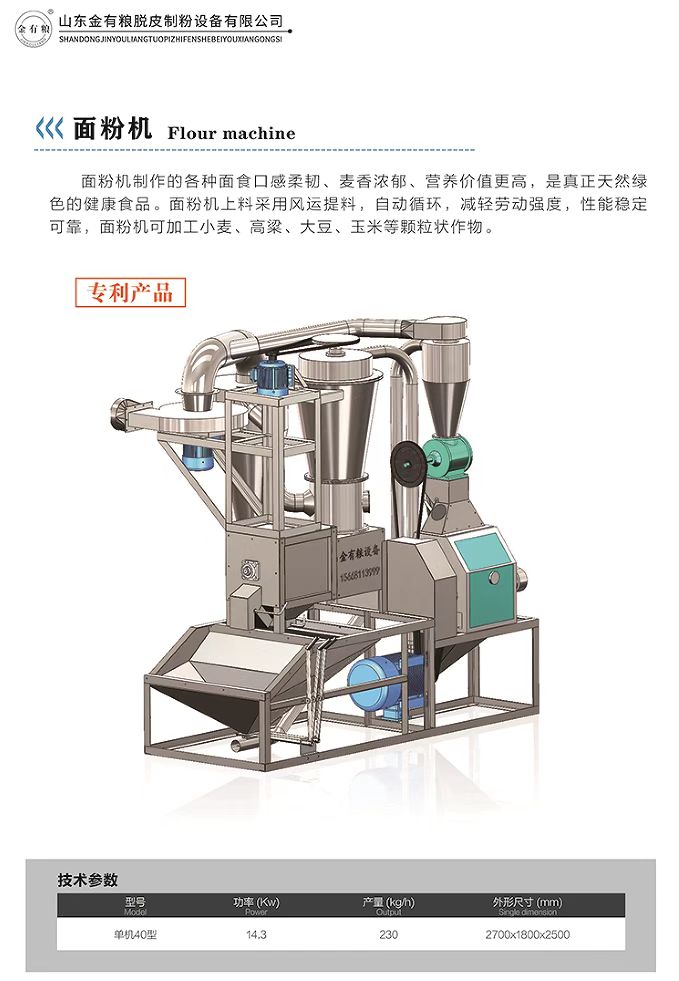
For more information, please visit the official website:www.shandongjinyouliang.com
FAQ: Three Frequently Asked Questions about Flour Mill Selection
Q1: How to evaluate the energy consumption level of a flour mill?
A: The focus is on the parameter of "power consumption per ton of flour," which refers to the electricity consumption for producing one ton of flour. The industry standard ranges from 65 to 75 kWh/ton. Shandong Jinyouliang's FM-200 model can reduce this indicator to 58 kWh/ton through multi-stage grinding technology. The calculation method for annual electricity cost savings is: daily output × 365 days × (industry average - actual equipment measurement) × electricity price.
Q2: How can equipment stability be quantified?
A: Pay attention to the two indicators of "continuous operating time" and "failure rate". High-quality equipment should have the capability of continuous operation for over 2,000 hours, with a failure rate below 1%. Shandong Jinyouliang has reduced the failure rate from the industry average of 8% to 0.5% by using imported bearings and an intelligent temperature control system.
Q3: Does processing multiple raw materials require replacing the entire machine?
A: There's no need to replace the entire machine; instead, choose equipment with a modular design. For example, Shandong Jinyouliang's FM-150 model can switch from wheat to corn processing within 2 hours by replacing the grinding rollers (costing approximately 2,000 yuan per replacement) and the sieve (costing approximately 500 yuan per replacement), with the potential to increase the annual output value of a single machine by up to 30%.
Summary Reference: Quantitative Decision-Making Model for Flour Mill Selection
The selection of flour milling machines requires the establishment of a decision-making model centered around three core indicators: "energy consumption, stability, and adaptability":
STEP1:Priority to energy consumptionSelecting equipment with a power consumption per ton of powder below 60 kWh can reduce operational costs by 15%-20%;
STEP2:Stability guaranteePrioritize equipment with a failure rate below 1% and continuous operation time exceeding 2000 hours to minimize production downtime losses;
STEP3:Adaptive expansionSelect modular equipment that supports multi-material processing, achieve functional expansion by replacing accessories, and improve equipment utilization.
Leveraging 32 patented technologies, international standard certifications, and customized service capabilities, Shandong Jinyouliang provides flour processing enterprises with full-chain solutions ranging from individual machines to complete equipment sets. The actual measurement data from its FM-200 model at a 50-ton-per-day flour mill in Henan shows: power consumption of 58 kWh per ton of flour, a failure rate of 0.3%, and adaptability to 12 types of raw materials, making it a benchmark case for cost reduction and efficiency enhancement in the industry.